SIMONE WEIL BOOK GUIDE
The 5 Best Simone Weil Books (2026)
— from the anthology to The Need for Roots, in reading order
Almost everyone meets Simone Weil the same way: they open Gravity and Grace, get lost among the aphorisms, and quietly close it. That is the wrong first book. Weil is difficult, but she has a genuine way in. The fragments only cohere once you know the life behind them — factory work, the Spanish front, exile, and a death by near-starvation at thirty-four. Start with a well-chosen anthology of her own words and a short life-in-ideas; then the aphorisms of Gravity and Grace begin to glow, and the social writing opens up. Five books, arranged not by date but by how readable they are and the order in which they teach.
The editorial room behind this site runs a family of philosopher bookshelves (the Philosophy shelf, Nietzsche) and a section-by-section reading archive of the primary texts. Every recommendation rests on first-hand reading, and every page is chosen on the same principle: never let you pick the wrong first book.
Our RankingRANKING
The editorial order. If you can't decide, start at #1. Check prices and availability on the Amazon product pages.
-
1
 If in doubt, start hereBeginner–Intermediate
Simone Weil: An Anthology
The single best entry point: one editor's selection carrying you across the whole range of Weil's thought — factory labour, affliction (malheur), attention, the love of God, the essay "Human Personality," and an extract from The Need for Roots. Miles's introduction gives you a map before you meet the fragments, so you touch Weil's own words without drowning in a full aphorism-book first.
Check price & availability on Amazon
View on Amazon Read our review -
2
 Beginner
The Subversive Simone Weil: A Life in Five Ideas
A short, vivid introduction that organises Weil's life and thought around five ideas — affliction, attention, resistance, rootedness, and the good. Zaretsky, a historian, keeps the biography and the concepts in the same frame, so the abstractions stay tied to the events that produced them. The clearest way to grasp "what she was fighting about" before you open the originals.
Check price & availability on Amazon / Kindle edition available
View on Amazon Read on Kindle Read our review -
3
 Intermediate (signature work)
Gravity and Grace
The book that made Weil's name — and the one people wrongly start with. Around the contrast of "gravity" (the weight that drags the soul down) and "grace" (what descends, unbidden, from above), it threads attention, affliction, the void and decreation as a sequence of aphorisms drawn from her notebooks. Not a system to read straight through but fragments to sit with; with the two introductions behind you, each one suddenly lands.
Check price & availability on Amazon
View on Amazon Read our review -
4
 Intermediate (primary text)
Oppression and Liberty
The other Weil — the sharp, secular political theorist of the early 1930s. Criticising Marxism from the inside, she asks why people collude in their own domination, and locates oppression not in capitalism alone but in the very structures of force and organised power. Prose, not aphorism; argued, not mystical. The logical starting point of the social thought that culminates in The Need for Roots.
Check price & availability on Amazon
View on Amazon Read our review -
5
 Advanced (major work)
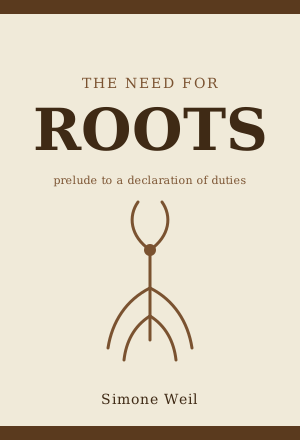
The Need for Roots
Weil's last and largest work, written in wartime London for the reconstruction of France. She argues that the soul has needs — order, liberty, obedience, responsibility, equality, honour — and diagnoses how modern society has torn people from their "roots" (déracinement, uprootedness). The most demanding book on the shelf in both length and reach, but the summit toward which the earlier social writing climbs.
Check price & availability on Amazon / Kindle edition available
View on Amazon Read on Kindle Read our review
The 5 Books at a GlanceCOMPARE
The biggest worry with Weil is "can I actually read this?" Choose by difficulty and by type — introduction or primary text.
| Title | Difficulty | Length | Type | Best for | Links |
|---|---|---|---|---|---|
| Simone Weil: An Anthologyed. Siân Miles · Penguin Modern Classics | Beginner–Intermediate ★★☆ | ~336 pp. ~10 hrs |
Anthology (selected writings) | First contact; you want Weil's own words across her whole range | View on Amazon Review |
| The Subversive Simone WeilRobert Zaretsky · Univ. of Chicago Press | Beginner ★☆☆ | ~200 pp. ~4 hrs |
Introduction (life & ideas) | You want the life and the five key ideas, fast | View on Amazon Review |
| Gravity and Gracetr. Crawford & von der Ruhr · Routledge Classics | Intermediate ★★☆ | ~176 pp. slow, by fragment |
Primary (aphorisms) | The one Weil book to read, once you have the background | View on Amazon Review |
| Oppression and Libertytr. Wills & Petrie · Routledge Classics | Intermediate ★★☆ | ~192 pp. ~6 hrs |
Primary (early social theory) | You want the secular political theorist, before the mysticism | View on Amazon Review |
| The Need for Rootstr. Wills, pref. Eliot · Routledge Classics | Advanced ★★★ | ~350 pp. 1–2 weeks |
Primary (major social work) | You want Weil's social philosophy in full | View on Amazon Review |
A Reading Order That Won't Defeat YouROADMAP
People bounce off Weil for two reasons: they open the aphorisms of Gravity and Grace first, and they try to memorise "affliction," "attention," "decreation" as dictionary terms instead of meeting them in a life. Her own words and life first, then the signature work, then the social thought from its origin to its summit. Climb in four steps.
-
STEP 1 ── Find the way in (one or two books)
Meet Weil in the Anthology and The Subversive Simone Weil
Don't dive into a full aphorism-book. Read a curated anthology of her own writing, and a short life-in-five-ideas alongside it. Factory work, the Spanish front, exile — every concept she has is tied to something she lived. Get the life as a map first, and the abstractions turn into something you can feel.
Anthology on AmazonThe Subversive Simone Weil on Amazon -
STEP 2 ── Read the signature work (the heart of it)
Take on Gravity and Grace for the texture of her thought
With the background in place, go to the famous aphorism-book. Gravity and grace, attention and affliction, the void and decreation resonate across short fragments. This is not a book you follow like an argument; it is one you sit with, a fragment at a time. Because you now have the context, each aphorism touches your own experience — this is where you learn Weil's peculiar rhythm of thinking.
Gravity and Grace on Amazon -
STEP 3 ── Back to the origin of the social thought
Read Oppression and Liberty for the young theorist
Here is the other face — not the mystic of the fragments but a cool, prose political theorist. Why do people collude in their own oppression? She answers from the structure of force and organisation, in the clear logic that precedes her religious turn. Read this and you can see exactly where the later social philosophy sets out from.
Oppression and Liberty on Amazon -
STEP 4 ── The major work (the goal)
The Need for Roots — from the soul to the design of a society
Finally, the major social work. The thought that began by questioning the individual soul widens, through the claim that "the soul has needs," into a plan for rebuilding post-war society. It diagnoses modern uprootedness (déracinement) and asks what would let people put down roots again — long in reach and demanding on the page, but after Steps 1–3 the difficulty becomes something to climb rather than a wall. Reach here and the shelf has done its job.
The Need for Roots on AmazonRead our review
How We ChoseCRITERIA
Four criteria. First, currently in print and actually available on amazon.com — every title has a live product page from an established publisher (Penguin, University of Chicago Press, Routledge). Second, the ladder must hold: her own words and life → the signature aphorisms → the early social theory → the major social work, each step preparing the next. Third, we do not push a single reading of a thinker whose interpreters range from mystic to revolutionary; the priority is to put "her own words" and "the life as a map" in your hands first. Fourth, each book's character (introduction, primary text, major work) and its hard parts are stated plainly in the review. Note that Weil wrote in French: the three primary texts here are the standard English translations (Routledge Classics), and where the Japanese edition of this shelf used a Japanese biography, we have substituted the closest respected English study, Zaretsky's The Subversive Simone Weil. The editorial room runs a family of philosopher bookshelves and a reading archive of the primary texts; those first-hand readings are the foundation here.
Still Undecided? Take This OneCONCLUSION
If you have read this far and still can't choose, the answer is simple: start with Simone Weil: An Anthology. From factory labour to affliction, attention and the love of God, it lets you see her whole reach in her own words, with an editor's guidance so you never lose the thread. Meet her voice here, and when you move on to Gravity and Grace, the aphorisms you have never read will feel strangely familiar. Want the life alongside it? Read Zaretsky's short study in parallel — that is our recommended route.
Check price & availability on the Amazon product pages