Home › Top 5 › Gravity and Grace
Review: Gravity and Grace — Weil's signature work, read in the right order
★★★★★4.6 / 5.0 (editorial rating)
Verdict: the essential Weil — and the most misused. A book of aphorisms, not arguments, it rewards slow, repeated reading and defeats almost everyone who opens it cold. Come to it third, after the anthology and a life-in-ideas, and it turns luminous.
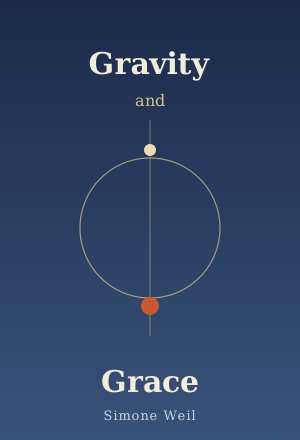
- Title
- Gravity and Grace (La Pesanteur et la grâce)
- Author
- Simone Weil, tr. Emma Crawford & Mario von der Ruhr
- Publisher
- Routledge Classics (this ed. 2002; French original 1947)
- Length
- Primary source · ~176 pp. (aphorisms, thematically arranged)
- Difficulty
- Intermediate ★★☆ — easy words, hard thought
Check price & availability on the Amazon product page
What it is — in three lines
Before her death, Weil left her notebooks with the farmer and writer Gustave Thibon. From them he selected and arranged passages by theme, and published them in 1947 as La Pesanteur et la grâce — the first of her books to appear, and the one that made her famous. So this is not a treatise Weil sat down to write but a distillation of her private thinking, edited by another hand. The Routledge Classics edition gives the complete text in a modern translation. Chapters carry titles like "The Void," "Attention and Will," "Affliction," "Decreation."
Why not to start here
Everything that makes Gravity and Grace great also makes it the wrong first book. The central image is simple to state — "gravity" is the moral force that pulls the soul downward, toward self-protection and illusion; "grace" is what descends from above, which we can only make room for, not earn — but the aphorisms around it presuppose the whole of Weil. Read cold, "we must continually suspend the work of the imagination filling the void within ourselves" is a closed door. Read after the anthology and Zaretsky, the same line opens, because you now know what void, imagination and attention mean for her.
Attention, taken to its highest degree, is the same thing as prayer.
— Simone Weil, Gravity and Grace (widely quoted; editorial reference)
This is a book to read a page at a time and return to, not to finish. Its unit is the aphorism, and its reward comes from sitting with one until it yields.
Three highlights
1. Attention
Weil's idea of attention — a patient, self-emptying openness that is close to love and, at its limit, to prayer — is her single most influential contribution, and it is here in its purest form. Read slowly, these pages change how you think about thinking.
2. Decreation and the void
Her hardest and most original moves: that we must "decreate" the self we insist on, and refuse to fill the void with consoling illusions. Difficult, occasionally forbidding, unforgettable once grasped.
3. The aphorism as form
Because Thibon arranged fragments by theme, the book reads like a book of spiritual exercises. That form is a feature: it invites re-reading, and it is why the volume has stayed in print for three-quarters of a century.
What to watch out for
Two honest notes. First, remember whose book this is: Thibon chose and ordered these passages. It is faithful to Weil's notebooks but it is a selection, and the sequence is his editorial architecture, not her finished design — a point worth keeping in mind before treating any single aphorism as her last word. Second, translation matters more here than almost anywhere, because so much rides on a few charged words (malheur, décréation); if a rendering stops you, check it against the anthology's versions. None of this is a reason to skip the book — only a reason to read it third, and slowly.
Check price & availability on the Amazon product page