Home › Top 5 › Simone Weil: An Anthology
Review: Simone Weil: An Anthology — the best first book on Weil
★★★★☆4.5 / 5.0 (editorial rating)
Verdict: the right place to begin. Weil's own words, across her whole range, with an editor's hand to guide you — that is exactly what a first reader needs and exactly what a full aphorism-book withholds. Meet her voice here, and everything else on the shelf opens more easily.
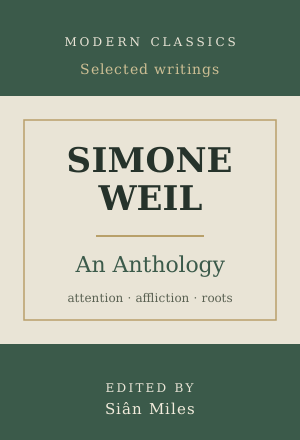
- Title
- Simone Weil: An Anthology
- Editor
- Siân Miles (selection, introduction, some translations)
- Publisher
- Penguin Modern Classics (this selection first published 1986)
- Length
- Anthology · ~336 pp.
- Difficulty
- Beginner–Intermediate ★★☆ — guided, but the ideas are real
Check price & availability on the Amazon product page
What it is — in three lines
Simone Weil (1909–1943) wrote a great deal but published little in her lifetime; most of her work reached the world posthumously and in pieces. This Penguin volume is an editor's single-volume selection that ranges across her whole output — early political essays, the factory writings, the reflections on affliction and attention, the religious pieces, the famous essay "Human Personality," and an extract from The Need for Roots. Siân Miles frames the selection with a substantial introduction. Less a book Weil wrote than a well-built door into everything she wrote.
Why it can be your first Weil
The reason is the shape. A newcomer who opens Gravity and Grace meets hundreds of aphorisms with no context and usually gives up; a newcomer who opens The Need for Roots meets a 350-page argument and stalls. An anthology solves both problems at once: you get Weil's actual sentences — not a paraphrase — but arranged and introduced so that each piece has a footing. You can read an essay in a sitting and feel you have understood something, then follow the thread to the next. It is the rare introduction that does not stand between you and the writer; it simply chooses where you stand.
Miles's introduction is genuinely useful on the hardest thing about Weil — the way her life and her ideas are welded together, so that "attention" or "affliction" are not abstractions but names for things she did and suffered. Read it first and the abstractions arrive already anchored.
Three highlights
1. "Human Personality"
One of Weil's greatest single essays sits in this volume: her argument that what is sacred in a human being is not the "person" or their rights but something impersonal and more fundamental. It is demanding, but it is Weil at full stretch, and having it in an introductory anthology is a real gift.
2. The range in one place
Factory journal, war, God, beauty, force, the state — the selection lets you see, in an afternoon of dipping, just how wide Weil's reach was. That panorama is exactly what tells you which of the primary texts to read next.
3. An editor who trusts the reader
Miles introduces and arranges, but she does not simplify Weil into a slogan. The selection keeps the difficulty and the contradictions; it just gives you somewhere to stand while you face them.
What to watch out for
Two honest notes. First, an anthology is a set of choices — another editor would cut differently, and no selection is "all of Weil." Treat it as the doorway it is, not the whole house; the primary texts on this shelf are where you go next. Second, even guided, Weil is not light reading: "Human Personality" and the pieces on affliction ask real effort. The value here is not that the ideas are made easy, but that they are made approachable in the right order.
Check price & availability on the Amazon product page