Home › Top 5 › The Subversive Simone Weil
Review: The Subversive Simone Weil — a life in five ideas
★★★★☆4.4 / 5.0 (editorial rating)
Verdict: the fastest honest way in. A short book that keeps Weil's life and her ideas in the same frame, so you understand what she was fighting about before you open a primary text. Read it next to the anthology and the two do the whole job of orientation.
- Title
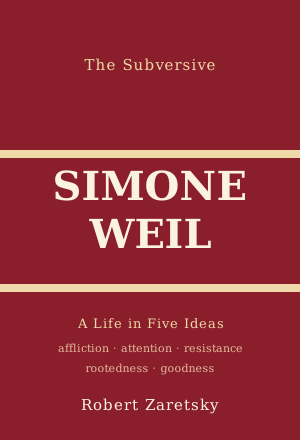
- The Subversive Simone Weil: A Life in Five Ideas
- Author
- Robert Zaretsky
- Publisher
- University of Chicago Press (2021; paperback 2023)
- Length
- Introduction / study · ~200 pp.
- Difficulty
- Beginner ★☆☆ — brisk, essayistic, warm
Check price & availability on the Amazon product page
What it is — in three lines
Robert Zaretsky, a historian of French thought, gives a compact portrait of Weil organised not by chronology but by five of her central ideas: affliction, attention, resistance, rootedness, and the good. Each chapter braids a strand of her turbulent life — the teaching, the factory, the Spanish front, the exile, the early death — with a clear account, and honest criticism, of the idea it produced. A short book that stands in for a full biography without losing the thought.
Why the five-ideas frame works
Weil is hard to introduce because she is so many people at once — the rigorous rationalist who was also a mystic, the revolutionary with a soft spot for anarchism who nonetheless distrusted the party, the humanitarian who preferred the language of obligation to the language of rights. A plain cradle-to-grave biography tends to make these look like inconsistencies. Zaretsky's five-ideas structure turns the contradictions into the subject, showing how a single restless mind arrived at each position. Crucially, he keeps the life in view throughout, so "affliction" comes with the factory and the war attached, and "attention" is a discipline she practised, not a slogan.
He also does not idolise her. Where Weil is exasperating — her extremism, her hard sayings about the self — he says so, which paradoxically makes the case for her more persuasive.
Three highlights
1. Attention, made concrete
The chapter on attention is the clearest short account we know of the idea that runs through all of Weil — attention as a moral and almost religious act, close to love. It sends you back to the anthology and forward to Gravity and Grace better equipped.
2. The life carried lightly
Zaretsky is a graceful writer, and the biographical material — the union organising, the assembly line, the refusal to eat more than occupied France — arrives without hagiography. You feel why she has been called "the patron saint of outsiders" and why that phrase is also a warning.
3. It respects the reader's next step
The book is plainly a doorway, not a substitute. It quotes and points outward, so you finish it wanting the primary texts rather than feeling you have been given a tidy summary in their place.
What to watch out for
Two honest notes. First, this is an introduction and interpretation, not Weil herself — a fine guide, but a guide; read it with the anthology so that her own sentences stay in front of you. Second, a note on our lineup: the Japanese edition of this shelf used a Japanese-language biography in this slot. There is no English translation of that book, so we have substituted the closest respected English study — this one — and say so openly. Zaretsky argues a view of Weil; other studies (for instance Palle Yourgrau's short critical life, or Francine du Plessix Gray's brief biography) frame her differently, and any of them would serve the same role.
Check price & availability on the Amazon product page