Home › Top 5 › Oppression and Liberty
Review: Oppression and Liberty — the young, secular Weil
★★★★☆4.2 / 5.0 (editorial rating)
Verdict: the Weil people don't expect. A rigorous, secular political theorist dismantling Marxism from the inside and asking why domination endures. It reads as argument, not aphorism, and it is the logical starting point of the social thought that ends in The Need for Roots.
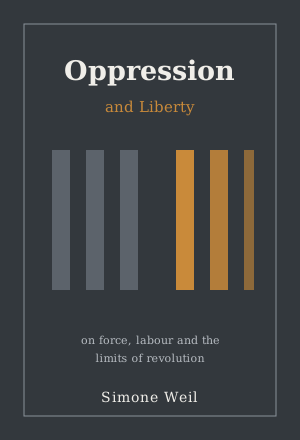
- Title
- Oppression and Liberty
- Author
- Simone Weil, tr. Arthur Wills & John Petrie
- Publisher
- Routledge Classics (essays of the 1930s, collected posthumously)
- Length
- Primary source · ~192 pp.
- Difficulty
- Intermediate ★★☆ — argued prose, some political background assumed
Check price & availability on the Amazon product page
What it is — in three lines
Written mostly in the early-to-mid 1930s and collected after her death, Oppression and Liberty gathers Weil's political essays, centred on the long "Reflections Concerning the Causes of Liberty and Social Oppression." Here she is a working political thinker — she had read Marx closely, organised with trade unionists, and would soon go to the factory floor and the Spanish front. The mysticism is not yet in view; this is analysis. The question that drives it: what actually produces oppression, and can revolution end it, or only relocate it?
Why it belongs on the shelf
Because it corrects the single biggest distortion in how Weil is read. The popular image is all affliction and grace; this book shows the hard-edged theorist who criticised Marxism from within — accepting much of its analysis while rejecting its faith that a change of ownership would abolish domination. Weil locates oppression not in capitalism alone but in the very structure of force, and in the way large-scale organisation concentrates power over those it coordinates. It is a bracingly unromantic argument, and prophetic about the twentieth century's revolutions.
For our purposes it is also the logical first half of Weil's social philosophy. Read it and The Need for Roots stops looking like a religious eccentric's utopia and starts looking like the constructive answer to a diagnosis she had been building for a decade.
Three highlights
1. The critique of Marxism from the inside
Not an outsider's dismissal but a sympathiser's dissection: Weil keeps Marx's materialist eye while denying his optimism. That combination is rare and clarifying.
2. Oppression as a problem of force and organisation
Her claim that domination is rooted in the structure of collective power — not merely in a class or an economic system — is the analytical heart of the book, and the seed of her later idea that people can be "uprooted" by the very institutions meant to serve them.
3. A sober view of revolution
Weil refuses the consolation that the next upheaval will free anyone. Written in the 1930s, it reads now as unnervingly clear-eyed.
What to watch out for
Two honest notes. First, this is the most "political-theory" book on the shelf: it assumes some acquaintance with Marx and the debates of the interwar left, and it argues rather than sings. If you came to Weil for the mystic, the register here is different — that is the point, but be ready for it. Second, it is a posthumous collection of pieces written over several years, so it has the unevenness of essays rather than the unity of a designed book; read the long "Reflections" as the spine and the rest as context.
Check price & availability on the Amazon product page