Home › Top 5 › The Need for Roots
Review: The Need for Roots — from the soul to the design of a society
★★★★☆4.3 / 5.0 (editorial rating)
Verdict: the summit. Weil's fullest attempt to move from the needs of the individual soul to the design of a whole society — demanding in length and reach, occasionally strange, and unlike anything else in political thought. Save it for last; earn it with the other four.
- Title
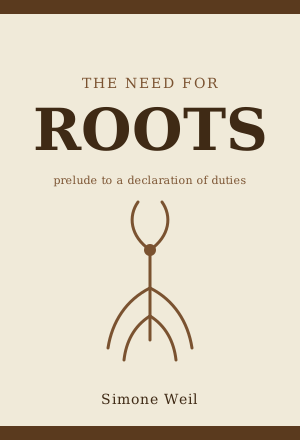
- The Need for Roots: Prelude to a Declaration of Duties Towards Mankind
- Author
- Simone Weil, tr. Arthur Wills; preface by T. S. Eliot
- Publisher
- Routledge Classics (written 1943; French original L'Enracinement, 1949)
- Length
- Primary source · ~350 pp.
- Difficulty
- Advanced ★★★ — long, wide-ranging, occasionally severe
Check price & availability on the Amazon product page
What it is — in three lines
In 1943, in London, working for the Free French and with only months to live, Weil wrote a report on the moral and spiritual reconstruction of France after the war. Published posthumously as L'Enracinement, it opens with a startling claim — that we should speak first of human obligations, not human rights — and sets out the "needs of the soul": order, liberty, obedience, responsibility, equality, hierarchy, honour, punishment, freedom of opinion, security, risk, private property, truth. It then diagnoses uprootedness (déracinement), the tearing of people from the places, work and traditions that give life meaning. T. S. Eliot's preface introduces the English edition.
Why it is the goal of the shelf
Because it completes the arc. Oppression and Liberty diagnosed why domination endures; The Need for Roots asks what a society would have to provide for people to flourish rather than merely survive. It is Weil's most constructive book — the point where the discipline of attention and the analysis of force are turned toward institutions, education, labour and nationhood. Read after the other four, its odd-seeming premises (duties before rights, the soul's need for "obedience" and "hierarchy" as much as "liberty") read not as piety but as the considered conclusions of everything before.
To be rooted is perhaps the most important and least recognised need of the human soul.
— Simone Weil, The Need for Roots (widely quoted; editorial reference)
You will not agree with all of it. But you will not read anything else quite like a political programme grounded in the soul's needs, written by someone dying for the cause it serves.
Three highlights
1. Obligations before rights
Weil's inversion — that what we owe others is more fundamental than what we can claim — is one of the twentieth century's genuinely original political ideas, and it opens the book.
2. The needs of the soul
Her list pairs opposites on purpose: liberty and obedience, equality and hierarchy, security and risk. The claim that a healthy society must satisfy both sides of each pair is strange, demanding, and hard to forget.
3. Uprootedness
Her diagnosis of déracinement — in work, in the nation, among the uprooted poor — is the book's dark centre and its most prophetic stretch, speaking directly to a century of displacement.
What to watch out for
Two honest notes. First, this is the hardest book on the shelf, and not only in length: it ranges across history, education, religion and labour, and some passages (on hierarchy, on national feeling, on Rome and Israel) are severe and have been much argued over. Read it as a provocation to think with, not a manifesto to sign. Second, it is unfinished and posthumously assembled — Weil died before she could revise it — so expect the roughness of a last draft rather than the polish of a completed treatise. Neither is a reason to skip it; both are reasons to come to it last, with the other four behind you.
Check price & availability on the Amazon product page