TIBETAN BUDDHISM BOOK GUIDE
The 5 Best Tibetan Buddhism Books (2026)
— an introduction, and a reading order to the Book of the Dead
You have heard of The Tibetan Book of the Dead; perhaps you opened it, met a rush of unfamiliar words — bardo, mandala, the peaceful and wrathful deities — and quietly closed it again. That is the usual way in, and the usual place people stop. There is a gentler staircase. The common mistake is starting with a famous primary text. Get the shape of the whole tradition from a short, reliable introduction first; meet its living face; then walk into the practice literature and the primary texts, and the same pages read completely differently. This shelf ranks five respected English books not by fame but by readability and the order that builds understanding — a map for not giving up.
The editorial room behind this site runs a family of philosopher and thought bookshelves (see The Philosophy Bookshelf and The Nietzsche Bookshelf) and a section-by-section reading archive of primary texts. We present these books neutrally and with respect for the tradition — describing what each one is, not advocating a path.
Our RankingRANKING
The editorial order. If you can't decide, start at #1. Check prices and availability on the Amazon product pages.
-
1
 If in doubt, start hereBeginner
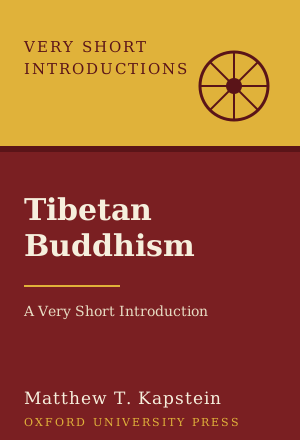
Tibetan Buddhism: A Very Short Introduction
The single best entry point: a compact, authoritative survey by a leading scholar of Tibetan religion. In about 150 pages it lays out the history, the schools, the core ideas — karma and rebirth, the bodhisattva path, tantra — and the place of death in the tradition, so the scattered images (mandalas, the Dalai Lama, the Book of the Dead) connect into one picture. Read this and everything else has a home to return to.
Check price & availability on Amazon / Kindle edition available
View on Amazon Read on Kindle Read our review -
2
 Beginner
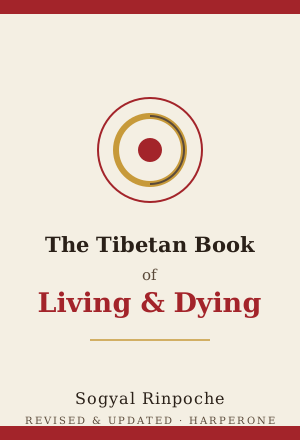
The Tibetan Book of Living and Dying
The book that carried Tibetan Buddhist teaching on death to a worldwide readership. Written for the general reader, it presents impermanence, karma and rebirth, the nature of mind, meditation, and the care of the dying — drawing on the same bardo teachings behind the Book of the Dead, but in warm, accessible prose. The living, human face of the tradition, and the gentlest way to feel why death sits at its center.
Check price & availability on Amazon / Kindle edition available
View on Amazon Read on Kindle Read our review -
3
 Intermediate
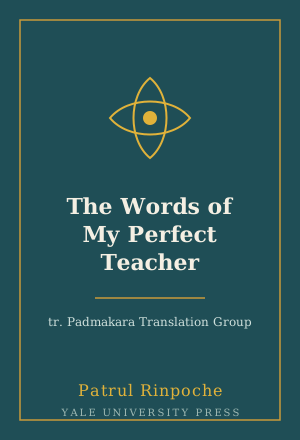
The Words of My Perfect Teacher
A beloved nineteenth-century classic and the standard manual of the foundational (ngöndro) practices of the Nyingma school. Patrul Rinpoche explains the preliminaries of the path — the precious human life, impermanence, karma, compassion, and the teacher–student relationship — through stories, humor, and plain talk. This is where an outside reader meets the tradition's own practice literature, in a widely praised translation recommended by senior teachers.
Check price & availability on Amazon
View on Amazon Read our review -
4
 Advanced
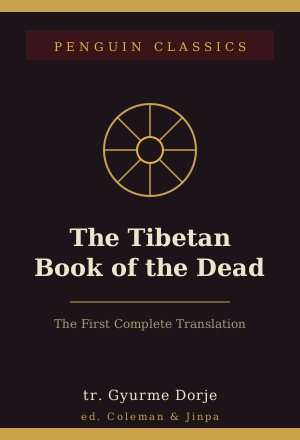
The Tibetan Book of the Dead: First Complete Translation
The famous primary text, given its fullest English rendering. Known in Tibetan as the Bardo Thödol — "Liberation through Hearing in the Intermediate State" — it is read aloud to guide consciousness through the bardo between death and rebirth. This Penguin Classics edition, with an introduction by the Dalai Lama, translates the complete cycle rather than a fragment. Renowned, but genuinely demanding: build a foundation before you open it.
Check price & availability on Amazon / Kindle edition available
View on Amazon Read on Kindle Read our review -
5
 Intermediate
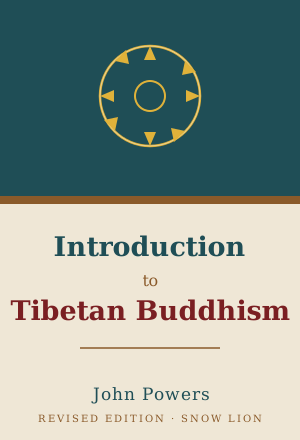
Introduction to Tibetan Buddhism (Revised Edition)
The comprehensive scholarly survey — the reference you keep on the shelf. Powers traces the Indian origins, the Mahayana philosophy and tantric methods, and the four main schools together with Bön, all from a nonsectarian standpoint. Where the Very Short Introduction gives you the outline in an afternoon, this fills it in at length: a standard university-level overview to return to whenever a term or a school needs unpacking.
Check price & availability on Amazon
View on Amazon Read our review
The 5 Books at a GlanceCOMPARE
The biggest worry with a tradition this unfamiliar is "can I actually read this?" Choose by difficulty and by type — primer, living tradition, practice text, primary source, or reference.
| Title | Difficulty | Length | Type | Best for | Links |
|---|---|---|---|---|---|
| Tibetan Buddhism: A Very Short IntroductionMatthew T. Kapstein · OUP | Beginner ★☆☆ | ~152 pp. ~4 hrs |
Short introduction | One book to get the whole shape of the tradition | View on Amazon Review |
| The Tibetan Book of Living and DyingSogyal Rinpoche · HarperOne | Beginner ★☆☆ | ~425 pp. ~2 weeks |
Living tradition | The accessible, human face of the teaching on death | View on Amazon Review |
| The Words of My Perfect TeacherPatrul Rinpoche · Yale UP | Intermediate ★★☆ | ~457 pp. 2–3 weeks |
Practice text (classic) | Meeting the tradition's own foundational practice manual | View on Amazon Review |
| The Tibetan Book of the Deadtr. Gyurme Dorje · Penguin Classics | Advanced ★★★ | ~592 pp. weeks+ |
Primary source | Reading the famous primary text, in full | View on Amazon Review |
| Introduction to Tibetan BuddhismJohn Powers · Snow Lion | Intermediate ★★☆ | ~592 pp. reference |
Scholarly survey | A comprehensive reference to keep and return to | View on Amazon Review |
A Reading Order That Won't Defeat YouROADMAP
Two things usually defeat readers here: starting with a primary text like the Book of the Dead, and trying to memorize the vocabulary (emptiness, karma, mandala, bardo) as if from a dictionary. Overview → the living tradition and its practice → the scholarly map → the primary text. Climb in four steps.
-
STEP 1 ── Get the shape of the whole (one book)
Read the Very Short Introduction for the outline
Do not dive into a primary text. Start with Kapstein's short, authoritative survey to see what Tibetan Buddhism actually is — its history, its schools, and how ideas like karma, rebirth, and tantra fit together. Once the terms connect, the rest of the shelf has somewhere to land.
Very Short Introduction on Amazon -
STEP 2 ── Meet the living tradition and its practice (books 2–3)
Feel it through Living and Dying, then The Words of My Perfect Teacher
Sogyal Rinpoche's modern classic puts a warm, human face on the teaching about death and the mind; then Patrul Rinpoche's nineteenth-century manual shows the tradition's own foundational practices from the inside. Together they take you from "what it says" to "how it is lived."
Living and Dying on AmazonPerfect Teacher on Amazon -
STEP 3 ── Fill in the map (reference)
Keep Powers' Introduction to Tibetan Buddhism at hand
When a school, a term, or a stretch of history needs unpacking, Powers' comprehensive survey is the reference to reach for. You need not read it cover to cover; use it to consolidate what the shorter books introduced, and to steady yourself before the primary text.
Introduction to Tibetan Buddhism on Amazon -
STEP 4 ── The primary text (the goal)
Take on The Tibetan Book of the Dead in its complete translation
Now the famous text. Gyurme Dorje's complete translation, introduced by the Dalai Lama, lets you read the whole Bardo Thödol cycle rather than a fragment. It is demanding — but after the four steps above, its imagery reads not as exotic mystery but as the culmination of everything you have met. Reach here and the shelf has done its job.
The Tibetan Book of the Dead on AmazonRead our review
How We ChoseCRITERIA
Three criteria. First, currently in print and actually available on amazon.com from established publishers — Oxford University Press, HarperOne, Yale University Press, Penguin Classics, and Snow Lion (Shambhala). Second, the ladder must hold: short overview → the living tradition and its practice → a scholarly reference → the primary text, each step preparing the next, with entry points at every height. Third, honesty and neutrality about what each book is: a short introduction is a map, a bestselling modern classic is one teacher's presentation, a nineteenth-century manual is the tradition's own practice literature, and the Book of the Dead is a primary text — the reviews say exactly which, and present them with respect rather than advocacy. The Japanese edition of this shelf recommends Japanese-language books; because those are not available in English, this edition substitutes the closest respected English works for the same roles, and says so. Our judgements rest on the works themselves and on explicit bibliographic checking.
Still Undecided? Take This OneCONCLUSION
If you have read this far and still can't choose, the answer is simple: start with Tibetan Buddhism: A Very Short Introduction. In about 150 pages a leading scholar gives you the history, the schools, and the core ideas, so every other book — the modern classic, the practice manual, the primary text — has a place to sit. Get the map first; then, when you are ready, walk toward the Book of the Dead. That is the route this shelf recommends.
Check price & availability on the Amazon product pages