Home › Top 5 › Introduction to Tibetan Buddhism
Review: Introduction to Tibetan Buddhism — the comprehensive reference
★★★★★4.5 / 5.0 (editorial rating)
Verdict: the survey you keep and return to. Where the pocket introduction gives the outline, this fills it in at length — Indian origins, Mahayana philosophy, tantric method, and the four schools plus Bön, all treated nonsectarially. Not a book you must read cover to cover, but the reference that steadies you before the primary text and answers the questions the shorter books raise.
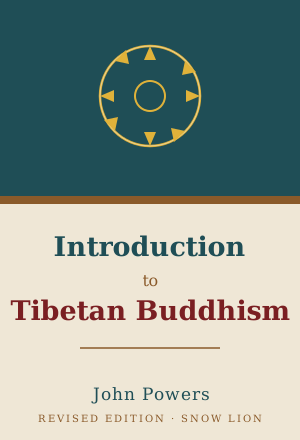
- Title
- Introduction to Tibetan Buddhism (Revised Edition)
- Author
- John Powers
- Publisher
- Snow Lion (Shambhala Publications)
- Length
- Scholarly survey · ~592 pp.
- Difficulty
- Intermediate ★★☆ — readable, but comprehensive
Check price & availability on the Amazon product page
What it is — in three lines
John Powers' Introduction to Tibetan Buddhism is a widely used single-volume survey of the whole tradition, first published in 1995 and substantially expanded in the revised edition. In some six hundred pages it covers the Indian background and the transmission of Buddhism to Tibet, the core doctrines, the practices of meditation and tantra, and the four main schools — Nyingma, Kagyü, Sakya, and Geluk — together with the older Bön tradition, treated even-handedly. Comprehensive, well-referenced, and written for students and general readers alike, it is the standard book-length introduction in English — the reference the shorter titles point back to.
Why it earns a place on the shelf
Every other book here does one thing well: the Very Short Introduction gives you the outline fast, Living and Dying gives you the living voice, The Words of My Perfect Teacher gives you the tradition from inside, and the Book of the Dead gives you a primary text. Powers gives you the connective tissue — the full account in which all of those sit. When a school's history is unclear, when a technical term needs a proper definition, when you want the doctrinal background behind a practice, this is where you look. It is less a book to be read straight through than a survey to live alongside the others, and it is the natural place to consolidate before taking on the primary text.
Its nonsectarian stance matters, too. By laying the schools side by side without promoting one, it keeps a newcomer from mistaking a single lineage's view for the whole — the same neutral footing this shelf tries to keep.
Three highlights
1. Genuinely comprehensive
History, doctrine, meditation, tantra, and all four schools plus Bön in one volume, with references onward. For breadth of coverage in a single book, it has few rivals in English.
2. Nonsectarian by design
Powers presents the traditions comparatively rather than devotionally, which is exactly what an outside student needs to avoid taking a part for the whole.
3. Built to be used
Clear organization and referencing make it easy to dip into for a specific school, figure, or term — a working reference, not just a read-once survey.
What to watch out for
Two honest notes. First, it is long, and it is a survey. Read end to end it can feel like a textbook; it is more rewarding used as a reference — read the chapters you need, consult the rest. That is why this shelf places it as a companion to the primary text rather than as a first read; for the quick orientation, start with the Very Short Introduction. Second, breadth has a cost: on any single topic, a specialist study will go deeper. Take it for what it is — the best comprehensive map in one volume, and the steadying reference to keep at your elbow through the rest of the shelf.
Check price & availability on the Amazon product page