Home › Top 5 › Tibetan Buddhism: A Very Short Introduction
Review: Tibetan Buddhism: A Very Short Introduction — the map before the territory
★★★★☆4.4 / 5.0 (editorial rating)
Verdict: the first book to read, with almost nothing to argue about. One short paperback that hands you the whole shape of the tradition — history, schools, and core ideas — from a scholar who has spent a career with the sources. Read this and every other book on the shelf has a place to sit.
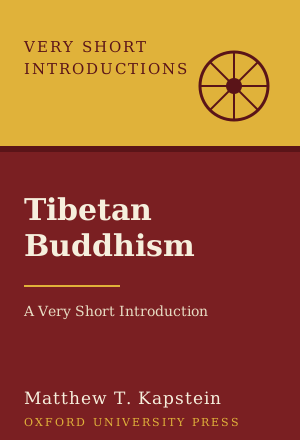
- Title
- Tibetan Buddhism: A Very Short Introduction
- Author
- Matthew T. Kapstein
- Publisher
- Oxford University Press (Very Short Introductions)
- Length
- Short introduction · ~152 pp.
- Difficulty
- Beginner ★☆☆ — reads in an afternoon or two
Check price & availability on the Amazon product page
What it is — in three lines
This is Oxford's pocket-sized survey of Tibetan Buddhism, written by Matthew T. Kapstein, a specialist in Tibetan religion who has taught in Paris and Chicago. In roughly 150 pages it moves through the world in which the tradition took shape, the sources it drew from India, the growth of the schools, the bodhisattva path and philosophical debates, tantric practice, and the tradition's teachings on dying and death — closing with Tibetan Buddhism in the modern world. Less a doctrine than a compact, reliable orientation: what this tradition is, in outline, from someone who knows the field.
Why it belongs first
The value here is proportion. A newcomer's difficulty is rarely any single idea; it is that the pieces — mandalas, the Dalai Lama, reincarnate teachers, the Book of the Dead, emptiness, tantra — arrive as disconnected fragments. Kapstein's book sets them in relation to one another, so that karma and rebirth, the bodhisattva vow, and the tantric path read as parts of one structure rather than exotic curiosities. Because it is written by a scholar for general readers, it neither flattens the tradition into slogans nor drowns you in technicality; it gives you the frame, and names what you are looking at.
That is exactly what you want from a first book. You can read it in a sitting or two, and you close it able to place whatever you read next — a popular classic, a practice manual, or a primary text — somewhere on a map you now hold.
Three highlights
1. The whole arc, in the right proportions
History, schools, philosophy, practice, and death each get their measured share. Nothing is inflated into mystery; nothing essential is skipped. For orientation, that balance is worth more than any single deep dive.
2. Scholarly, but genuinely readable
Kapstein writes for the curious non-specialist without condescending. Technical terms are introduced as needed and explained, not assumed — the ideal register for a reader meeting the tradition for the first time.
3. A neutral survey, not a sermon
This is a description of a tradition, not an invitation to adopt it. That neutral, comparative stance is precisely why it makes such a dependable base camp before the more devotional or primary texts.
What to watch out for
Two honest notes. First, it is short by design. A survey of this size names far more than it can develop; you will finish with a good map and many questions, which is the point — later books on this shelf answer them. Second, an outline is not an experience: this book tells you that death sits at the center of the tradition and why, but it does not put you inside that teaching the way The Tibetan Book of Living and Dying or the primary texts do. Take it for what it is — the map, not the territory.
Check price & availability on the Amazon product page