Home › Top 5 › The Tibetan Book of Living and Dying
Review: The Tibetan Book of Living and Dying — the living face of the teaching
★★★★☆4.5 / 5.0 (editorial rating)
Verdict: the book that brought Tibetan Buddhist teaching on death to millions of general readers. Warm, accessible, and built around the same bardo teachings as the primary texts — but written to be lived with, not decoded. After the map, this is the gentlest way to feel why death sits at the heart of the tradition.
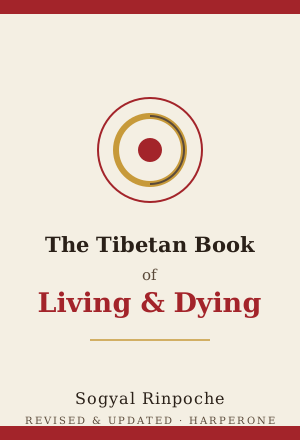
- Title
- The Tibetan Book of Living and Dying (Revised & Updated Edition)
- Author
- Sogyal Rinpoche, edited by Patrick Gaffney & Andrew Harvey
- Publisher
- HarperOne (first published 1992)
- Length
- Modern classic · ~425 pp.
- Difficulty
- Beginner ★☆☆ — accessible, though a substantial read
Check price & availability on the Amazon product page
What it is — in three lines
First published in 1992 and translated into dozens of languages, this is among the most widely read presentations of Tibetan Buddhism ever written. Sogyal Rinpoche, working with the editors Patrick Gaffney and Andrew Harvey, draws on the bardo teachings — the same body of thought behind The Tibetan Book of the Dead — to speak to a general Western readership about impermanence, karma and rebirth, the nature of mind, meditation, compassion, and the care of the dying. Not a scholarly survey and not a primary text, but a teacher's presentation, written to be useful at the bedside and in daily life.
Why it works as the accessible entry
The bardo literature can feel forbidding from the outside — lists of deities, unfamiliar terms, a cosmology that arrives all at once. This book takes the same core insight and delivers it through plain language, contemporary examples, and stories. It connects the teaching to experiences a modern reader already has: grief, fear of death, the wish to help someone who is dying. Where Kapstein's Very Short Introduction tells you death is central and why, this book lets you feel it — which is exactly the step that turns an outline into understanding.
It is also, quietly, a bridge to the primary text. Read this first and the imagery of the Book of the Dead — the luminosity at the moment of death, the peaceful and wrathful appearances, the mind meeting its own projections — arrives already softened and prepared, rather than cold.
Three highlights
1. The teaching made human
Impermanence and the nature of mind are presented not as abstractions but as things to notice in ordinary life. That grounding is what makes the book so widely used by people who never intended to study Buddhism.
2. On caring for the dying
Its chapters on accompanying the dying and the bereaved have made it a companion in hospices and palliative care well beyond Buddhist circles — a rare crossover from a religious text into practical care.
3. A gentle on-ramp to the bardo
By presenting the intermediate-state teachings in accessible form, it prepares you for the primary text without pretending to replace it. It is a doorway, and an honest one.
What to watch out for
Two honest notes. First, this is one teacher's presentation for a general audience, not a neutral survey or a primary source. It selects, simplifies, and frames the material for accessibility; keep the Very Short Introduction and Powers' survey nearby for the balanced scholarly picture, and treat the primary text as the thing itself. Second, at over four hundred pages it is accessible but not short; it rewards steady reading rather than a single sitting. Take it as what it is — the warm, living face of the tradition, and a bridge, not the destination.
Check price & availability on the Amazon product page