Home › Top 5 › The Tibetan Book of the Dead
Review: The Tibetan Book of the Dead — the primary text, read with a foundation
★★★★☆4.3 / 5.0 (editorial rating)
Verdict: the destination of this shelf — the famous primary text, in its fullest English form. A guide read aloud to the dying and the dead, to lead consciousness through the bardo toward liberation. Renowned, and genuinely demanding. Approached after the earlier books, its imagery reads not as exotic mystery but as the culmination of everything you have met.
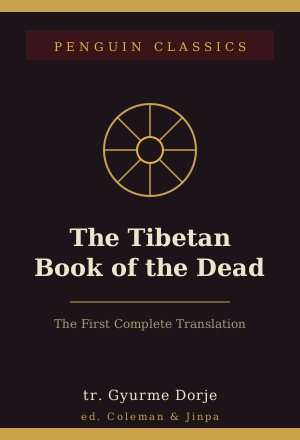
- Title
- The Tibetan Book of the Dead: First Complete Translation (Penguin Classics Deluxe Edition)
- Translator
- Gyurme Dorje; edited by Graham Coleman with Thupten Jinpa; introductory commentary by the Dalai Lama
- Publisher
- Penguin Classics (composed from the terma tradition of Padmasambhava)
- Length
- Primary source · ~592 pp.
- Difficulty
- Advanced ★★★ — famous, but a genuine primary text
Check price & availability on the Amazon product page
What it is — in three lines
The work known in the West as The Tibetan Book of the Dead is called in Tibetan the Bardo Thödol — often rendered "Liberation through Hearing in the Intermediate State." Traditionally attributed to the eighth-century master Padmasambhava and preserved as a "treasure" (terma) text, it is a set of instructions read aloud to a dying or dead person over the days of the bardo, the intermediate state between death and the next rebirth. This Penguin Classics edition, translated by the Tibetanist Gyurme Dorje and introduced by the Dalai Lama, gives the first complete English translation of the whole cycle — not the single famous chapter, but the full ritual text.
The heart of it — a voice across the bardo
The title "Book of the Dead" is a Western coinage; the Tibetan name points to the real idea — liberation through hearing. The text speaks directly to the consciousness of the one who has died, describing what it will meet in the intermediate state: the clear light at the moment of death, then the appearances of peaceful and wrathful deities, then the pull toward a new birth. To each appearance it says, in effect, the same thing: what you see is not an external reality but the projection of your own mind — do not fear it; recognize it, and be free. The luminous imagery that can look like fantasy from outside is, read from within the tradition, the logical culmination of its teaching that mind gives rise to what it experiences. That is why a foundation changes everything: after the introductions, the practice manual, and the survey, these pages read as a system's conclusion, not a curiosity.
Three highlights
1. The complete cycle, not a fragment
Most popular versions present only the best-known section. This edition translates the whole ritual corpus, so you meet the text as it actually functions rather than as an anthology piece.
2. Scholarship you can lean on
Gyurme Dorje's translation and the accompanying apparatus, with the Dalai Lama's introduction, give the general reader real scholarly support for a text that badly needs it.
3. "Mind gives rise to appearance," at the limit
The teaching that experience is the mind's own projection is here pressed to the extreme case of death itself. For a reader who has built up to it, that is the intellectual and spiritual payoff of the whole shelf.
What to watch out for — famous, but hard
Two honest notes. First, this is a primary text, not an explanation. Opened without preparation, its lists of deities and ritual detail overwhelm most readers — which is exactly why it sits last here. Come to it after the Very Short Introduction, Living and Dying, The Words of My Perfect Teacher, and Powers' survey, and the difficulty turns from a wall into a climb worth making. Second, in the West this text has a long history of being read through mystical, psychedelic, or psychological lenses quite foreign to it. This complete, scholarly edition sets it back in its own tradition; reading it that way — foundation first, then the text itself — is the most respectful approach.
Check price & availability on the Amazon product page