Home › Top 5 › The Words of My Perfect Teacher
Review: The Words of My Perfect Teacher — the tradition's own practice manual
★★★★★4.6 / 5.0 (editorial rating)
Verdict: the point where an outside reader meets the tradition from the inside. A revered nineteenth-century manual of the foundational practices, delivered not as dry doctrine but through stories, humor, and blunt plain talk. In the Padmakara Translation Group's widely praised English, it is demanding in substance yet unexpectedly warm on the page.
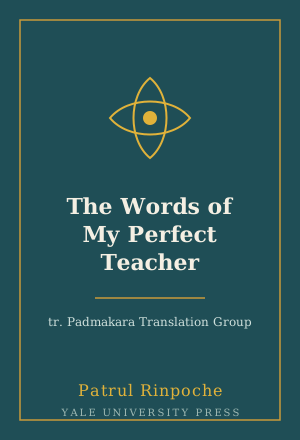
- Title
- The Words of My Perfect Teacher
- Author
- Patrul Rinpoche (1808–1887), tr. Padmakara Translation Group
- Publisher
- Yale University Press (foreword by the Dalai Lama)
- Length
- Practice classic · ~457 pp.
- Difficulty
- Intermediate ★★☆ — plain-spoken, but substantial
Check price & availability on the Amazon product page
What it is — in three lines
Written down in the nineteenth century from the oral teaching of Patrul Rinpoche, this is the classic exposition of the ngöndro — the foundational or preliminary practices — of the Longchen Nyingtik cycle within the Nyingma, the oldest school of Tibetan Buddhism. It walks the reader through the groundwork of the path: the value and rarity of a human life, impermanence and death, the workings of karma, the sufferings of existence, compassion, and the relationship between teacher and student. A practical guide to inner transformation, and one of the tradition's own most-loved teaching texts — here in the Padmakara Translation Group's respected English rendering, with a foreword by the Dalai Lama.
Why it matters here
Introductions describe a tradition from outside; this book speaks from inside it. It is not a survey of Tibetan Buddhism but an instruction manual within it — the kind of text a student would actually study under a teacher. Reading it, you stop looking at the tradition and start hearing its own voice: how it frames a human life, why it dwells on impermanence, what it asks of a practitioner before anything advanced begins. That shift — from about to within — is exactly what the earlier books prepare you for, and what makes the later primary text legible rather than alien.
Patrul Rinpoche's manner is the surprise. For a foundational religious text it is remarkably direct and often funny, full of earthy anecdotes and sharp asides, which is precisely why it has been loved for well over a century and why it survives translation so well.
Three highlights
1. The foundations, laid in order
Precious human life, impermanence, karma, the nature of suffering, compassion — the classic sequence of the preliminaries, set out clearly. It shows how the tradition builds a practitioner from the ground up.
2. Teaching through story
Abstract points are carried by vivid anecdotes and homely comparisons rather than technical argument. This is oral teaching preserved on the page, and it reads that way — human, immediate, memorable.
3. A benchmark translation
The Padmakara Translation Group's version is widely regarded as a model of clarity and fidelity, and comes recommended by senior teachers. It is the standard English gateway to this classic.
What to watch out for
Two honest notes. First, this is a devotional practice text, not a neutral overview. It speaks from within a specific school and assumes the framework the introductions give you — read it after the Very Short Introduction, not before, or the assumptions will feel abrupt. Second, its subject is inner practice under guidance; as an outside reader you are looking in on a manual meant to be studied with a teacher, and it is worth reading it in that spirit — as a window into how the tradition trains its own, rather than a self-help program. Taken that way, few books bring a newcomer closer to the living heart of Tibetan Buddhism.
Check price & availability on the Amazon product page