JEAN-JACQUES ROUSSEAU BOOK GUIDE
The 5 Best Jean-Jacques Rousseau Books (2026)
— from a short introduction to the Social Contract, in reading order
"Man is born free, and everywhere he is in chains." The philosopher of nature, the general will, and the modern self is one of the most quoted of the greats — and one of the easiest to start in the wrong place. Reach first for the Social Contract and its abstractions about the "general will" can turn you straight back. Rousseau has a staircase you can actually climb. Meet the man in the late Reveries or a short introduction, take the measure of the problem in the Discourse on Inequality, then read the masterwork itself — and, if it grips you, the great book on education, Emile. Five books, in an order that works.
The editorial room behind this site runs a family of philosopher bookshelves — for example The Philosophy Bookshelf and Socrates — and a section-by-section reading archive of the primary texts (in Japanese). Every recommendation rests on first-hand reading, and every page here follows one rule: never let the first book be the wrong one.
Our RankingRANKING
The editorial order. If you can't decide, start at #1. Check prices and availability on the Amazon product pages.
-
1
 If in doubt, start hereIntermediate
The Social Contract
Rousseau's masterwork of political philosophy, and the one book to read if you read only one. It asks where legitimate political authority can come from, and answers with the "social contract": people keep their freedom by giving all their rights to the whole community, whose collective will — the famous general will — becomes the source of law. A founding text of modern democracy, in Cranston's clear Penguin translation.
Check price & availability on Amazon
View on Amazon Read our review -
2
 IntermediateThe starting problem
Discourse on the Origin of Inequality
The "Second Discourse," Rousseau's early masterpiece of social criticism. He imagines humanity in a "state of nature" where inequality barely existed, and dates its rise to the moment someone first fenced off a plot of land and called it his own. From private property grows the whole apparatus of wealth, power, and domination. The problem to which the Social Contract is the answer.
Check price & availability on Amazon
View on Amazon Read our review -
3
 Beginner
Reveries of the Solitary Walker
Rousseau's last work, unfinished at his death: ten "walks" written in old age, when he felt misunderstood and alone, gathering memories, an ear for nature, and a searching self-examination into some of the most intimate prose he ever wrote. The gentlest way into Rousseau — you meet the man before the arguments.
Check price & availability on Amazon / Kindle edition available
View on Amazon Read on Kindle Read our review -
4
 Beginner
Rousseau: A Very Short Introduction
A short, authoritative map of Rousseau's whole project — nature and culture, inequality, the general will, education, religion, and the autobiographical writings — by Robert Wokler, one of the finest Rousseau scholars of his generation. The fastest way to see how the separate books fit into a single vision, and to dissolve the caricature of Rousseau as a mere "back to nature" romantic.
Check price & availability on Amazon
View on Amazon Read our review -
5
 Advanced
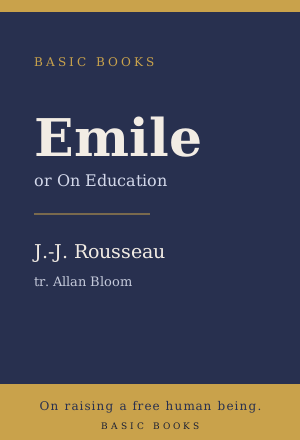
Emile, or On Education
Rousseau's great book on education, which he thought his best and most important. Following an imaginary pupil, Emile, from infancy to marriage, it asks how a naturally good human being can be raised without being corrupted by society — and becomes, along the way, a treatise on human nature itself. Long and demanding, in Allan Bloom's landmark translation with a substantial interpretive essay.
Check price & availability on Amazon
View on Amazon Read our review
The 5 Books at a GlanceCOMPARE
The biggest worry with Rousseau is "will the abstract political philosophy lose me?" Choose by difficulty and by type — introduction, primary text, and the personal writings.
| Title | Difficulty | Length | Type | Best for | Links |
|---|---|---|---|---|---|
| The Social Contracttr. Cranston · Penguin Classics | Intermediate ★★☆ | ~192 pp. ~5 hrs |
Primary (masterwork) | Reading one Rousseau in his own words | View on Amazon Review |
| Discourse on the Origin of Inequalitytr. Cress · Hackett | Intermediate ★★☆ | ~152 pp. ~4 hrs |
Primary (the problem) | Grasping Rousseau's critique of civilisation | View on Amazon Review |
| Reveries of the Solitary Walkertr. France · Penguin Classics | Beginner ★☆☆ | ~160 pp. ~4 hrs |
Primary (late memoir) | Meeting the man before the arguments | View on Amazon Review |
| Rousseau: A Very Short IntroductionRobert Wokler · OUP | Beginner ★☆☆ | ~176 pp. ~3 hrs |
Introduction | The whole map in one sitting | View on Amazon Review |
| Emile, or On Educationtr. Bloom · Basic Books | Advanced ★★★ | ~528 pp. 3–5 weeks |
Primary (magnum opus) | Rousseau on nature, education, and the whole human being | View on Amazon Review |
A Reading Order That Won't Defeat YouROADMAP
People bounce off Rousseau for two reasons: starting cold with the abstractions of the Social Contract, and trying to memorise "the general will" as a term before meeting the argument that gives it life. The personal writings or a short introduction → the problem of inequality → the masterwork → the great book on education. Climb in four steps.
-
STEP 1 ── Get on friendly terms (one book)
Meet Rousseau in the Reveries — or get the map from Wokler
Don't dive into the political philosophy yet. Spend an afternoon with the late Reveries of the Solitary Walker and you meet the human being behind the ideas; or read Wokler's Very Short Introduction and see the whole of Rousseau — nature, inequality, the general will, education — before you open a primary text. The point is to dissolve the "difficult" reputation first.
The Reveries on AmazonWokler's Introduction on Amazon -
STEP 2 ── Grasp the problem
The Discourse on the Origin of Inequality
Where did human inequality come from? Read Rousseau's answer — that private property and civilisation, not nature, produced it. Hold this question first and the Social Contract's "so what would a just society look like?" comes alive, because you already know the disease it is trying to cure.
The Discourse on Amazon -
STEP 3 ── The masterwork (the core)
Read the Social Contract, in his own words
Now the masterwork. With the problem of inequality in hand, the "general will" stops being a slogan and becomes an argument: how can people obey and stay free? Popular sovereignty, the generality of law, and the legitimacy of political power, in Rousseau's own voice. Finish this and you have read the heart of Rousseau in the original.
The Social Contract on Amazon -
STEP 4 ── The whole vision (the goal)
Take on Emile — nature, education, and the good life
Finish with the book Rousseau thought his most important. Emile follows one pupil from infancy to adulthood to ask how a naturally good person can be raised without being spoiled by society — and turns into Rousseau's fullest picture of human nature. Long and demanding, but reach it after the Discourse and the Social Contract and the whole system opens out. That is where this shelf was always heading.
Emile on AmazonRead our review
How We ChoseCRITERIA
Three criteria. First, currently in print and actually available on amazon.com — every title has a live product page from an established publisher (Penguin, Hackett, Oxford, Basic Books). Second, the ladder must hold: the personal writings or an introduction → the problem of inequality → the masterwork → the great book on education, each step preparing the next, with an entry point at every height from a three-hour primer to a 500-page classic. Third, honesty about what each book is: the Social Contract is the masterwork and the recommended one-book read; the Discourse sets the problem it answers; the Reveries is the late, private Rousseau, not political philosophy; Wokler's book is a modern introduction, not a primary text; and Emile is a long treatise, not a quick read. The reviews say so. The editorial room runs a family of philosopher bookshelves and a section-by-section archive of the primary texts (in Japanese); those first-hand readings are the foundation here.
Still Undecided? Take This OneCONCLUSION
If you have read this far and still can't choose: start with the Social Contract. It is the classic of classics on legitimate political authority and the "general will," and the one Rousseau to read if you read only one, in Cranston's clear Penguin translation. If the abstractions worry you, read the Discourse on the Origin of Inequality first to grasp the critique of civilisation that the masterwork sets out to answer — that is this shelf's recommended route.
Check price & availability on the Amazon product pages