Home › Top 5 › Reveries of the Solitary Walker
Review: Reveries of the Solitary Walker — meeting the man before the arguments
★★★★★4.6 / 5.0 (editorial rating)
Verdict: the gentlest way into Rousseau. His last work, left unfinished at his death — ten "walks" written in old age, when he felt misunderstood and alone — gathers memory, an ear for nature, and unguarded self-examination into some of the most intimate prose he ever wrote. No system, no jargon: you meet the human being first, and the political philosophy is easier for it.
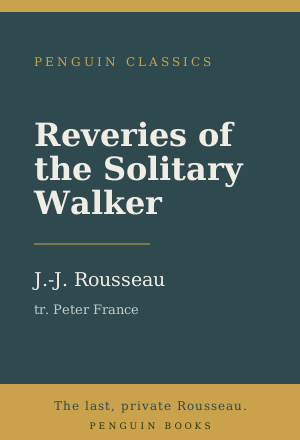
- Title
- Reveries of the Solitary Walker
- Author / Translator
- Jean-Jacques Rousseau; translated by Peter France
- Publisher
- Penguin Books (Penguin Classics)
- Length
- ~160 pp.
- Difficulty
- Beginner ★☆☆ — about four hours
Check price & availability on the Amazon product page
What it is — in three lines
The Reveries (written 1776–78, published after his death) is Rousseau's final work, left unfinished. It is a set of ten "walks" — loose, reflective essays composed on his rambles around Paris — in which an old and embittered Rousseau looks back over his life, records his responsiveness to nature, and examines his own heart. This is the most personal and intimate thing he wrote, here in Peter France's graceful Penguin Classics translation.
The core — the ten walks
There is no argument to follow here, only a mind at work on itself. Across the ten walks Rousseau remembers episodes from his life, defends himself against a world he feels has wronged him, and — most memorably, in the Fifth Walk on the Île de Saint-Pierre — describes moments of pure, contented existence in nature, when the self dissolves into a "feeling of existence" that needs nothing beyond itself. It is Romanticism before Romanticism, and the seedbed of the modern literature of the self.
I am now alone on earth, no longer having any brother, neighbour, friend, or society other than myself.
— Rousseau, Reveries, First Walk
What makes it the best entry point is that the same sensibility that drives the philosophy — the trust in nature, the suspicion of society, the intensity of inner feeling — is here in its purest, most human form.
Three highlights
1. The most accessible Rousseau
Short, personal, and jargon-free, it lets you get on friendly terms with the writer before you tackle a single political argument.
2. The Fifth Walk
The description of idle, happy hours on the Île de Saint-Pierre is one of the great passages on the pleasure of simply existing — worth the book on its own.
3. The birth of the modern self
Reading it, you watch a new kind of inner life enter literature; Romanticism, autobiography, and the cult of nature all trace back to this sensibility.
What to watch out for
Two honest notes. First, this is not political philosophy — do not come to the Reveries for the general will or the state of nature; come for the man. Its job on this shelf is to make Rousseau human before he is difficult. Second, it is coloured by his late sense of persecution, so the self-defence can feel one-sided; read it as testimony from inside a wounded life, not as impartial fact. Taken that way, it is disarming and moving.
Check price & availability on the Amazon product page