Home › Top 5 › Discourse on the Origin of Inequality
Review: Discourse on the Origin of Inequality — the moment inequality began
★★★★★4.8 / 5.0 (editorial rating)
Verdict: the "Second Discourse," Rousseau's early masterpiece and the sharpest statement of his critique of civilisation. He traces inequality back not to nature but to a single human act — the first person to fence off land and say "this is mine" — and follows it through property, wealth, and power. Read this first and the Social Contract reads as its answer. The problem, stated unforgettably.
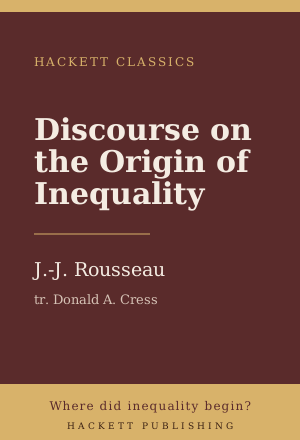
- Title
- Discourse on the Origin of Inequality
- Author / Translator
- Jean-Jacques Rousseau; translated by Donald A. Cress
- Publisher
- Hackett Publishing (Hackett Classics)
- Length
- ~152 pp. (text with introduction and notes)
- Difficulty
- Intermediate ★★☆ — about four hours
Check price & availability on the Amazon product page
What it is — in three lines
Written in 1755 for a prize essay set by the Academy of Dijon, the Second Discourse asks how inequality arose among human beings. Rousseau imagines a "state of nature" in which people are solitary, self-sufficient, and roughly equal, and argues that inequality is not natural but historical — the product of private property and the civilisation built on it. This is his foundational work of social criticism, here in Donald Cress's clear and widely used Hackett translation.
The core — property and the fall
The pivot of the whole argument is the birth of private property. In the state of nature, Rousseau argues, differences between people are small and cause little harm. Everything changes when land is enclosed:
The first man who, having enclosed a piece of ground, bethought himself of saying "This is mine," and found people simple enough to believe him, was the real founder of civil society.
— Rousseau, Discourse on the Origin of Inequality, Part II
From that moment, Rousseau traces how wealth, status, and political domination grow and harden — inequality is not written into human nature but manufactured by society, and then dressed up as natural and just. It is a genealogy of civilisation as a story of loss, and it sets the problem that the rest of Rousseau's political thought tries to solve.
Three highlights
1. Inequality as history, not nature
The core move — that inequality is made by society rather than given by nature — reframes a debate that is still ours, and you are reading it at the source.
2. The critique of civilisation
Rousseau's account of how "progress" produces domination is the seed of a whole tradition of social criticism, from Marx to modern critiques of consumer society.
3. The setup for the Social Contract
Reading the diagnosis here makes the cure there legible: the general will is Rousseau's answer to the disease this book describes.
What to watch out for
Two honest notes. First, the "state of nature" is a thought experiment, not anthropology — Rousseau is reasoning about what human beings would be without society, not reporting history, and he says so. Read it as a philosophical construction and it stops tripping you up. Second, this is the problem, not the solution: for Rousseau's positive politics you need the Social Contract, and for the whole picture of human nature, Emile. This book is the diagnosis.
Check price & availability on the Amazon product page