Home › Top 5 › Emile, or On Education
Review: Emile, or On Education — raising a free human being
★★★★★4.7 / 5.0 (editorial rating)
Verdict: the book Rousseau thought his best and most important. Following an imaginary pupil from infancy to marriage, it asks how a naturally good human being can be raised without being corrupted by society — and becomes, along the way, Rousseau's fullest picture of human nature itself. Long and demanding, but reach it after the Discourse and the Social Contract and the whole vision opens out. The goal of this shelf.
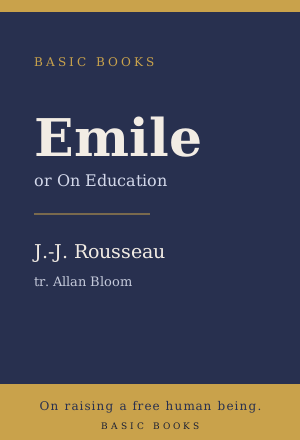
- Title
- Emile, or On Education
- Author / Translator
- Jean-Jacques Rousseau; translated with an introduction by Allan Bloom
- Publisher
- Basic Books
- Length
- ~528 pp. (text with introduction and notes)
- Difficulty
- Advanced ★★★ — a project of three to five weeks
Check price & availability on the Amazon product page
What it is — in three lines
Published in 1762, the same year as the Social Contract, Emile is Rousseau's great treatise on education. It follows a single imaginary boy, Emile, and his tutor from birth to adulthood, laying out an education designed to let his natural goodness develop rather than be deformed by society. But it is far more than a pedagogy: it is Rousseau's most complete account of human nature, feeling, and moral development — here in Allan Bloom's landmark translation, with Bloom's substantial interpretive essay.
The core — nature as the first teacher
Rousseau's guiding principle is that everything is good as it comes from the hands of nature, and degenerates in the hands of man. The tutor's art is therefore negative: not to cram the child with lessons and opinions, but to arrange the world so that nature and experience teach him in their own time. Book by book, Rousseau matches what is taught to the stage of development — the body first, then the senses, then reason, and only late the passions and moral life — culminating in the famous "Profession of Faith of the Savoyard Vicar," Rousseau's statement of natural religion.
God makes all things good; man meddles with them and they become evil.
— Rousseau, Emile, Book I
Read it after the political works and the connection is unmistakable: Emile is the Discourse's critique and the Social Contract's ideal worked out in a single human life.
Three highlights
1. Rousseau's own favourite
He called it his best and most important work; it is where his thought about nature, feeling, and society is most fully developed.
2. Bloom's translation and essay
Allan Bloom's version is the standard scholarly English Emile, and his long introductory essay is itself a major interpretation worth reading.
3. The whole human being
More than a theory of schooling, it is a picture of how a person becomes free and good — the positive counterpart to the critique in the Discourse.
What to watch out for
Two honest notes. First, it is long and uneven — part treatise, part novel, part sermon — and it rewards patience rather than speed; this is why we place it last, as the goal, not the entrance. Second, some of its content is genuinely dated and contested, above all Book V on the education of Sophie, Emile's intended wife, whose subordinate role has drawn justified criticism since Mary Wollstonecraft. Read it as a landmark to argue with, not a manual to apply, and it stays one of the essential books of the Enlightenment.
Check price & availability on the Amazon product page