Home › Top 5 › Rousseau: A Very Short Introduction
Review: Rousseau: A Very Short Introduction — the whole map in one sitting
★★★★★4.5 / 5.0 (editorial rating)
Verdict: the fastest way to see Rousseau whole. In under 200 pages Robert Wokler — one of the great Rousseau scholars — lays out nature and culture, inequality, the general will, education, and religion as parts of a single vision, so the separate books stop looking like separate problems. The map to unfold before you set out, and to keep beside you as you read the originals.
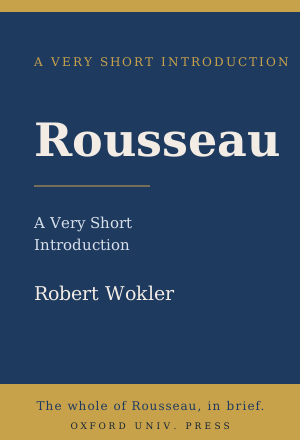
- Title
- Rousseau: A Very Short Introduction
- Author
- Robert Wokler
- Publisher
- Oxford University Press (Very Short Introductions)
- Length
- ~176 pp.
- Difficulty
- Beginner ★☆☆ — about three hours
Check price & availability on the Amazon product page
What it is — in three lines
Part of Oxford's Very Short Introductions series, this is a concise, authoritative overview of Rousseau's life and thought by Robert Wokler (1942–2006), among the most respected Rousseau scholars of his time. In a few short chapters it covers the critique of civilisation, the theory of inequality, the general will and politics, education, and religion — and shows how they hang together. It is scholarship written for the general reader, not a paraphrase of the primary texts.
The core — Rousseau as one vision
The great service of this little book is coherence. Read on their own, Rousseau's works can look like a bundle of contradictions — the critic of society who wrote its political constitution, the champion of nature who wrote a manual of education. Wokler shows the single thread running through them: the conviction that human beings are naturally good and made unhappy by badly-formed societies, and the lifelong search for the forms — political, educational, personal — in which natural goodness might survive. Get that thread and every primary text becomes easier.
Three highlights
1. Written by a leading authority
Wokler spent his career on Rousseau; this is not a hack summary but a distillation by someone who knew the texts and the scholarship intimately.
2. It connects the works
The Discourse, the Social Contract, and Emile stop being isolated set texts and become chapters of one argument about nature and society.
3. Genuinely short
You can read it in an afternoon and walk into the primary texts already oriented — the best possible use of three hours.
What to watch out for
Two honest notes. First, an introduction is scaffolding, not the building: Wokler's book is a map, and no map is the territory. Use it to orient yourself, then read Rousseau's own words — the point is to make the originals easier, not to replace them. Second, it is a work of interpretation, and a scholar's reading is a reading; Wokler has his emphases. Treat it as an expert's guided tour, not the last word, and it is exactly what a first-time reader needs.
Check price & availability on the Amazon product page