Home › Top 5 › The Social Contract
Review: The Social Contract — how the general will makes power legitimate
★★★★★5.0 / 5.0 (editorial rating)
Verdict: if you read one Rousseau in his own words, read this one. It opens with the most famous sentence in political philosophy — "Man is born free, and everywhere he is in chains" — and builds an argument for how legitimate authority rests on the general will of the people themselves. Abstract, but its reach is enormous: this is the masterwork, and the centre of the shelf, in Cranston's clear Penguin translation.
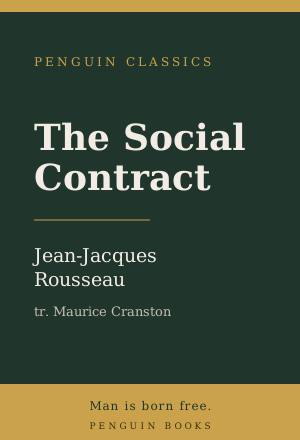
- Title
- The Social Contract
- Author / Translator
- Jean-Jacques Rousseau; translated by Maurice Cranston
- Publisher
- Penguin Books (Penguin Classics)
- Length
- ~192 pp. (text with introduction)
- Difficulty
- Intermediate ★★☆ — about five hours
Check price & availability on the Amazon product page
What it is — in three lines
Rousseau's 1762 masterwork asks where legitimate political authority can come from. His answer is the social contract: people form a community by giving all their rights to the whole, and in obeying the community's collective will they remain, paradoxically, as free as before. That collective will is the famous general will. This is the classic statement of popular sovereignty and a founding text of modern democracy, here in Maurice Cranston's clear Penguin Classics translation.
The core — the general will
The heart of the book, and its hardest idea, is the general will (volonté générale). It is not the sum of everyone's private wants (that is merely the "will of all"), nor the decision of a majority, nor the command of a ruler. It is the will of the community aimed at the common good. This abstraction is exactly what makes the book demanding — and exactly what makes it revolutionary, because it grounds the legitimacy of power in the people's own collective will rather than in force, tradition, or divine right.
Man is born free, and everywhere he is in chains.
— Rousseau, The Social Contract, Book I
Popular sovereignty, the generality of law, the difference between sovereign and government, and the notorious idea of a "civil religion" — the themes political thought has argued over ever since are concentrated here. Keep sight of the real question behind the abstractions — can there be order without domination? — and the book reads quickly.
Three highlights
1. The origin of popular sovereignty
Grounding the legitimacy of power in the will of the people is the starting point of modern democratic thought, and you are reading it at the source.
2. The reach of the general will
Once you grasp how it differs from the mere "will of all," the later debates of political philosophy — from the general good to majority rule — all come into view.
3. The force of the prose
From the opening sentence on, the book is full of epigrammatic, quotable lines; even at its most abstract, Rousseau writes to be read.
What to watch out for
Two honest notes. First, it is highly abstract, and readers who open it cold often stall on the general will. If you have not yet, read the Discourse on the Origin of Inequality first: hold Rousseau's critique of civilisation in mind and the masterwork's "so what would a just society look like?" comes alive. Second, this is political philosophy, not the whole of Rousseau — his picture of human nature and the good life is in Emile, and the private man is in the Reveries. This book is the core, not the complete Rousseau.
Check price & availability on the Amazon product page