NICHIREN BOOK GUIDE
The 5 Best Nichiren Books (2026)
— from an introduction to his own letters and treatises, in reading order
Nichiren (1222–1282) is one of the most uncompromising figures in the history of religion: a fisherman's son who concluded that the Lotus Sutra alone carried the whole truth of the Buddha, denounced every rival school, was twice exiled and once very nearly beheaded, and left behind a body of letters and treatises unlike anything else in medieval Japan. Reach first for his densest doctrinal writing, and the technical vocabulary — mappō, the daimoku, the three thousand realms in a single moment — can turn you straight back. Nichiren has a staircase you can actually climb. An accessible introduction, then his own letters, then the sutra he staked everything on, then the treatises, then the standard scholarly study. Five books, in an order that works.
The editorial room behind this site runs a family of thinker-and-tradition bookshelves — for example The Philosophy Bookshelf and Socrates — and a section-by-section reading archive of primary texts (in Japanese). Every recommendation rests on first-hand reading, and every page here is honest about one fact: Nichiren is a partisan writer, and the calmer you enter, the more clearly you can see what he was arguing for.
Our RankingRANKING
The editorial order. If you can't decide, start at #1. Check prices and availability on the Amazon product pages.
-
1
 If in doubt, start hereBeginner
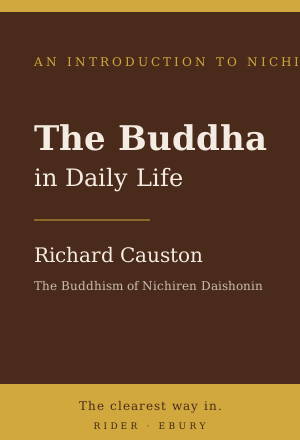
The Buddha in Daily Life: An Introduction to the Buddhism of Nichiren Daishonin
The most approachable English entry point: a clear, sympathetic account of Nichiren's core ideas — the Lotus Sutra, the chant of Nam-myoho-renge-kyo, the ten states of life, karma — written for the general reader. It is an introduction from within the living tradition rather than a neutral history, and our review says so plainly; but as a first, readable map of what Nichiren taught, nothing else in English is as easy to start.
Check price & availability on Amazon
View on Amazon Read our review -
2
 IntermediateBest primary text to start
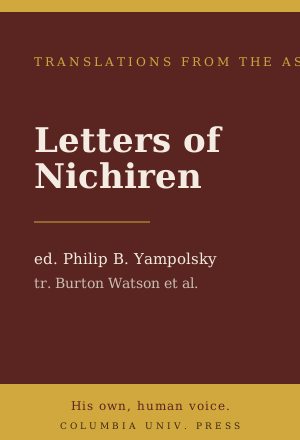
Letters of Nichiren
If you read Nichiren in his own words, start with the letters. Written to samurai, farmers, widows and lay followers, they show the doctrine at work in real lives — consolation in illness, courage under persecution, the meaning of chanting the daimoku. Translated by Burton Watson and colleagues for Columbia's Translations from the Asian Classics, this is Nichiren at his most human and most readable.
Check price & availability on Amazon
View on Amazon Read our review -
3
 Intermediate
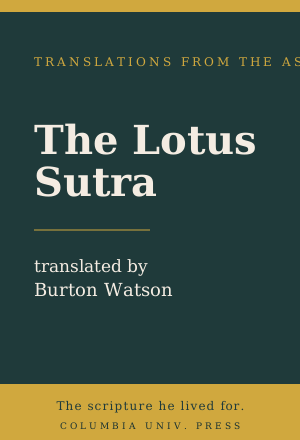
The Lotus Sutra
You cannot understand Nichiren without the scripture he built his life on. Burton Watson's Columbia translation of the Lotus Sutra (Myoho-renge-kyo) is the standard readable English version — the parables of the burning house and the prodigal son, the promise of buddhahood for all beings, the eternal Buddha of Chapter 16. Read it and Nichiren's absolute devotion to this one text stops being strange.
Check price & availability on Amazon
View on Amazon Read our review -
4
 Advanced
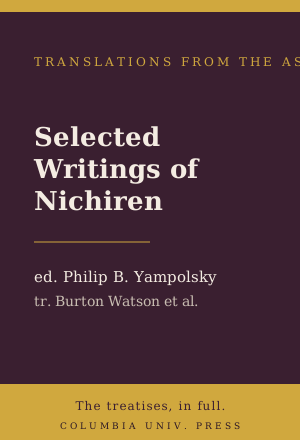
Selected Writings of Nichiren
The companion volume of major treatises: the works where Nichiren argues his case in full — On Establishing the Correct Teaching for the Peace of the Land (Risshō Ankoku Ron), The Opening of the Eyes (Kaimoku Shō), and more, with a substantial scholarly introduction. Demanding, polemical, and essential once the letters and the sutra have given you your bearings — this is the doctrine at full strength.
Check price & availability on Amazon
View on Amazon Read our review -
5
 Advanced
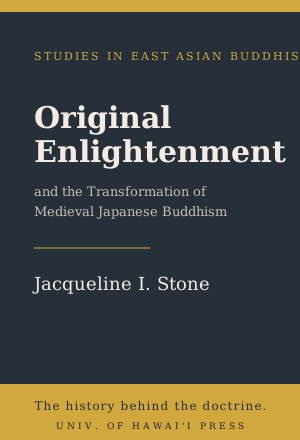
Original Enlightenment and the Transformation of Medieval Japanese Buddhism
The standard scholarly study of the doctrinal world Nichiren grew out of and against. Stone reconstructs medieval Tendai "original enlightenment" thought (hongaku) and shows how Nichiren, Dōgen and others transformed it — the book to reach for when you want the history behind the slogans, judged by a leading scholar of Japanese Buddhism. Difficult, but the finish that turns opinion into understanding.
Check price & availability on Amazon
View on Amazon Read our review
The 5 Books at a GlanceCOMPARE
The biggest worry with Nichiren is "will the doctrine and the polemics lose me?" Choose by difficulty and by type — introduction, primary source, scripture, scholarly study.
| Title | Difficulty | Length | Type | Best for | Links |
|---|---|---|---|---|---|
| The Buddha in Daily LifeRichard Causton · Rider/Ebury | Beginner ★☆☆ | ~304 pp. ~6 hrs |
Introduction | First contact; the whole map in one book | View on Amazon Review |
| Letters of Nichirened. Yampolsky, tr. Watson · Columbia | Intermediate ★★☆ | ~544 pp. read selectively |
Primary (letters) | Nichiren in his own, human voice | View on Amazon Review |
| The Lotus Sutratr. Burton Watson · Columbia | Intermediate ★★☆ | ~352 pp. ~10 hrs |
Scripture (source) | The text Nichiren staked everything on | View on Amazon Review |
| Selected Writings of Nichirened. Yampolsky, tr. Watson · Columbia | Advanced ★★★ | ~508 pp. a project |
Primary (treatises) | The doctrine argued in full | View on Amazon Review |
| Original Enlightenment…Jacqueline I. Stone · Hawai'i | Advanced ★★★ | ~562 pp. a project |
Study (scholarship) | The history behind the doctrine | View on Amazon Review |
A Reading Order That Won't Defeat YouROADMAP
People bounce off Nichiren for two reasons: starting with the densest doctrinal treatise, and trying to hold "mappō," "the daimoku," and "three thousand realms in a single moment" in mind before meeting the person and the scripture that give them life. Introduction → his own letters → the Lotus Sutra and the treatises → the scholarship. Climb in four steps.
-
STEP 1 ── Get the map (one book)
Read Causton's The Buddha in Daily Life
Don't open a treatise yet. Causton lays out the whole of Nichiren's Buddhism — the Lotus Sutra, the chant, the ten states of life, karma — for the general reader in a few evenings. Read it as an introduction from inside the tradition, not a neutral history, and it dissolves the sense that the doctrine is impenetrable.
Causton's Introduction on Amazon -
STEP 2 ── Hear his own voice (the human core)
The Letters of Nichiren
Now go to the source, but the accessible source first. Nichiren's letters to lay followers — grieving parents, frightened samurai, a woman facing childbirth — carry the doctrine inside real human situations, in Burton Watson's clear translation. Read a dozen of them and you have met Nichiren more truly than any summary can manage.
The Letters on Amazon -
STEP 3 ── The scripture and the treatises
The Lotus Sutra, then the Selected Writings
With the person in view, read the text he lived for — Watson's Lotus Sutra — and then the treatises where he argues his case at full strength, the Selected Writings: On Establishing the Correct Teaching and The Opening of the Eyes. Now "the Lotus Sutra alone" is not a slogan but a claim you can weigh.
The Lotus Sutra on AmazonSelected Writings on Amazon -
STEP 4 ── The scholarship (the goal)
Stone's Original Enlightenment
Finish with the history behind the doctrine. Jacqueline Stone reconstructs the medieval Tendai world of "original enlightenment" that Nichiren both inherited and overturned, and shows how his thought took shape against it. Reach it after the sources and you are reading a classic tradition with a scholar's eyes — which is where this shelf was always heading.
Stone's study on AmazonRead our review
How We ChoseCRITERIA
Three criteria. First, currently in print and actually available on amazon.com — every title has a live product page from an established publisher (Columbia University Press, University of Hawai'i Press, Rider/Penguin Random House). Second, the ladder must hold: introduction → his own letters → scripture and treatises → scholarly study, each step preparing the next, with an entry point at every height from a readable paperback introduction to a 560-page monograph. Third, honesty about what each book is: Causton's introduction is written from within the living tradition, not as neutral history, and the review says so; the letters and treatises are primary sources in translation; the Lotus Sutra is the scripture, not Nichiren's own words; Stone's book is scholarship. We do not promote any particular school or organisation — the aim is to hand you Nichiren's own words and the historical record first. The editorial room runs a family of bookshelves and a section-by-section archive of primary texts (in Japanese); those first-hand readings are the foundation here.
Still Undecided? Take This OneCONCLUSION
If you have read this far and still can't choose: start with Causton's The Buddha in Daily Life, then read a selection from the Letters of Nichiren. The introduction gives you the whole shape of Nichiren's Buddhism — the Lotus Sutra, the chant, karma, the ten states of life — in a few evenings, and the letters let you hear the man himself without wading into the hardest treatises first. That two-book route is this shelf's recommendation; everything else builds from there.
Check price & availability on the Amazon product pages