Home › Top 5 › The Lotus Sutra
Review: The Lotus Sutra — the scripture Nichiren lived for
★★★★★4.7 / 5.0 (editorial rating)
Verdict: you cannot understand Nichiren without this book. Watson's Columbia translation is the standard readable English Lotus Sutra — the parables, the promise of buddhahood for all beings, and the revelation of the eternal Buddha. Read it and Nichiren's total devotion to this one text, to the point of exile and near-execution, stops being strange and becomes intelligible.
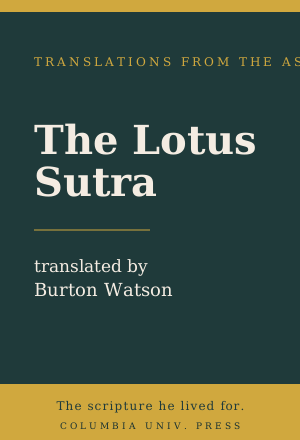
- Title
- The Lotus Sutra
- Translator
- Burton Watson (from Kumārajīva's Chinese)
- Publisher
- Columbia University Press (Translations from the Asian Classics)
- Length
- ~352 pp. (paperback)
- Difficulty
- Intermediate ★★☆ — about ten hours
Check price & availability on the Amazon product page
What it is — in three lines
One of the most influential Mahayana scriptures in East Asia, here in Burton Watson's translation from the classic Chinese version of Kumārajīva. It is not a book by Nichiren but the book behind him: the text he held to be the Buddha's supreme and final teaching, whose title he chanted as Nam-myoho-renge-kyo. Watson's version is the standard readable English Lotus Sutra for the general reader.
The core — one vehicle, and an eternal Buddha
Two great claims run through the sutra. The first is the "one vehicle": the many apparently different Buddhist teachings are expedient means leading to a single goal, and buddhahood is open to all beings without exception — a message the sutra drives home through its famous parables (the burning house, the prodigal son, the phantom city). The second, in Chapter 16, is the revelation that the Buddha's life span is immeasurable: the historical Buddha was an expedient appearance of an eternal, ever-present Buddha. For Nichiren, these were not poetry but the literal heart of the truth.
The parables — the burning house, the prodigal son — carry the doctrine of the one vehicle more powerfully than any argument.
— editorial gloss on the sutra's method
Even read purely as literature, the sutra's visionary scale — worlds shaking, a stupa rising from the earth, bodhisattvas beyond counting — is extraordinary. Read as Nichiren read it, it is the ground of everything he did.
Three highlights
1. The key to Nichiren
Nichiren's whole system is a reading of this text. Meet the parables, the one vehicle, and the eternal Buddha here, and his letters and treatises acquire a foundation instead of floating free.
2. Watson's readable English
The Columbia translation is prized for clarity: the verse and prose move, and Watson's brief introduction orients a first-time reader without heavy technical apparatus.
3. A scripture, not a treatise
It rewards a different kind of reading — imagistic, repetitive, incantatory — and that texture is itself worth experiencing, especially for anyone approaching Buddhist scripture for the first time.
What to watch out for
Two honest notes. First, this is scripture, not Nichiren. It tells you what he revered, not what he argued; for his own interpretation you still need the letters and the treatises. Second, the sutra's world is mythic and its structure repetitive by design — approach it expecting philosophical argument and you may be disappointed. Read it for its images and its central claims, and it opens up. Several other fine English versions exist (Reeves; Kubo & Yuyama), but Watson's is the standard readable choice and the one most convenient to pair with Watson's Nichiren translations.
Check price & availability on the Amazon product page