Home › Top 5 › Selected Writings of Nichiren
Review: Selected Writings of Nichiren — the treatises at full strength
★★★★★4.5 / 5.0 (editorial rating)
Verdict: Nichiren's doctrine, argued in full. This is the companion volume to the letters — the major treatises, including On Establishing the Correct Teaching for the Peace of the Land and The Opening of the Eyes, with a substantial scholarly introduction. Demanding and unapologetically polemical, it is essential once the letters and the Lotus Sutra have given you your bearings. Not a first book; a necessary one.
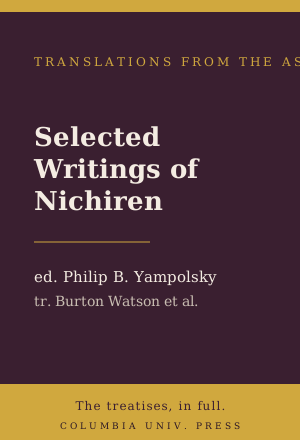
- Title
- Selected Writings of Nichiren
- Author / Editor / Translator
- Nichiren; edited by Philip B. Yampolsky; translated by Burton Watson and others
- Publisher
- Columbia University Press (Translations from the Asian Classics)
- Length / Format
- ~508 pp. — hardcover
- Difficulty
- Advanced ★★★ — a project, read with the introduction
Check price & availability on the Amazon product page
What it is — in three lines
The scholarly companion to the Letters: a selection of Nichiren's major treatises in the standard Columbia University Press translation, edited by Philip B. Yampolsky, with a long introduction setting Nichiren in his time. Where the letters are pastoral, these are Nichiren's public, argued works — the documents on which his reputation as one of the boldest religious thinkers of medieval Japan chiefly rests.
The core — the correct teaching, and the opening of the eyes
Two treatises anchor the volume. On Establishing the Correct Teaching for the Peace of the Land (Risshō Ankoku Ron, 1260), submitted to the shogunate, argues that the disasters afflicting Japan — famine, plague, the threat of invasion — flow from the country's abandonment of the true teaching, and calls for its restoration. The Opening of the Eyes (Kaimoku Shō), written during exile, is Nichiren's declaration of his own mission, staking his identity on his fidelity to the Lotus Sutra through persecution. Together they show the two poles of his thought: the reform of the nation, and the conviction of the self.
I will be the pillar of Japan; I will be the eyes of Japan; I will be the great vessel of Japan.
— the vow of The Opening of the Eyes (widely quoted; wording varies by translation)
The tone is uncompromising, sometimes harsh toward rival schools, and that intensity is not incidental — it is the argument taking the form Nichiren believed the crisis demanded.
Three highlights
1. The flagship treatises in one volume
The works everyone cites but few read in full are here, in reliable translation. If you want to judge Nichiren's actual arguments rather than summaries of them, this is where you do it.
2. A serious scholarly introduction
Yampolsky's editorial framing situates each treatise in Nichiren's biography and in the politics of Kamakura Japan, so the polemic is legible rather than merely startling.
3. The doctrine, unsoftened
Unlike an introduction, this does not smooth Nichiren's edges. You meet the exclusivity and the fire directly — which is the only honest way to assess them.
What to watch out for
Two honest notes. First, read the letters and the Lotus Sutra first. The treatises assume the scripture and reward the human acquaintance the letters give; come to them cold and the density and the polemic can overwhelm. Second, this is a hardcover scholarly edition, priced accordingly — check the product page. And be ready for the sectarian sharpness: Nichiren's denunciations of other schools are part of the record, not to be explained away, and best read alongside the historical perspective of Stone's study.
Check price & availability on the Amazon product page