Home › Top 5 › Original Enlightenment
Review: Original Enlightenment and the Transformation of Medieval Japanese Buddhism — the history behind the doctrine
★★★★☆4.4 / 5.0 (editorial rating)
Verdict: the finish that turns opinion into understanding. Stone's book is the standard scholarly study of medieval Tendai "original enlightenment" thought (hongaku) — the doctrinal water Nichiren swam in, and reacted against. Difficult and specialised, it is where the slogans acquire a history. Reach it after the primary sources and you read Nichiren with a leading scholar's eyes.
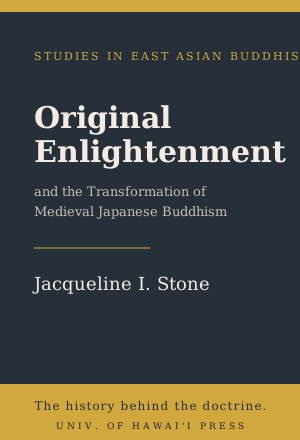
- Title
- Original Enlightenment and the Transformation of Medieval Japanese Buddhism
- Author
- Jacqueline I. Stone (scholar of Japanese Buddhism, Princeton)
- Publisher
- University of Hawai'i Press (Kuroda Institute, Studies in East Asian Buddhism)
- Length
- ~562 pp. (paperback)
- Difficulty
- Advanced ★★★ — a project, read slowly
Check price & availability on the Amazon product page
What it is — in three lines
A major work of scholarship on the intellectual world of Kamakura-era Japanese Buddhism, from a leading scholar in the field. Its subject is medieval Tendai hongaku ("original enlightenment") thought — the influential and slippery idea that all beings are already enlightened as they are — and how the "new" Kamakura schools, Nichiren's among them, took shape in relation to it. It is a study around Nichiren rather than a book solely about him, and that is its value.
The core — the doctrine of original enlightenment
Original-enlightenment thought held that enlightenment is not a distant goal to be attained but the true, present nature of reality and of every being. Stone reconstructs how this idea developed on Mount Hiei, how it was transmitted, and how it shaped — and was contested by — the founders of the new movements. For Nichiren this is the essential background: his insistence on the Lotus Sutra and the chant, and his sense of the Latter Day of the Law (mappō), are moves within and against this inherited framework, not ideas from nowhere.
To understand what Nichiren was rejecting, you first have to understand what "original enlightenment" claimed — which is exactly what this book supplies.
— editorial summary of the book's importance for Nichiren
The scholarship is careful, source-based, and alert to how easily hongaku ideas are misread; it is the opposite of a slogan.
Three highlights
1. The standard reference
On its subject this is the work others cite. If you want the historically responsible account rather than a devotional or polemical one, it is the destination.
2. Nichiren in context, not isolation
By situating him among his contemporaries and predecessors, Stone lets you see what was genuinely new in Nichiren and what he shared with his age — a perspective no primary source gives on its own.
3. A model of method
The book is also an education in how careful Buddhist-studies scholarship works: how texts are dated, transmissions traced, and later projections stripped away.
What to watch out for
Two honest notes. First, this is the last book on the shelf for a reason. It presupposes real acquaintance with the sources — read Causton, the letters, the Lotus Sutra, and ideally the treatises first, or the argument will feel remote. Second, it is a specialist monograph, not a life of Nichiren: it is broad on medieval Tendai and focused on doctrine, so do not come to it for biography or narrative. Read as the scholarly capstone it is, it is superb — and it is what keeps this shelf honest.
Check price & availability on the Amazon product page