Home › Top 5 › The Buddha in Daily Life
Review: The Buddha in Daily Life — the most approachable way in
★★★★☆4.2 / 5.0 (editorial rating)
Verdict: the single best first move for a general reader. In a few evenings Causton lays out the whole of Nichiren's Buddhism — the Lotus Sutra, the chant of Nam-myoho-renge-kyo, the ten states of life, karma — in plain English. It is an introduction written from inside the living tradition, not a neutral history, and we say so; read with that in mind, it is the easiest and clearest place to start.
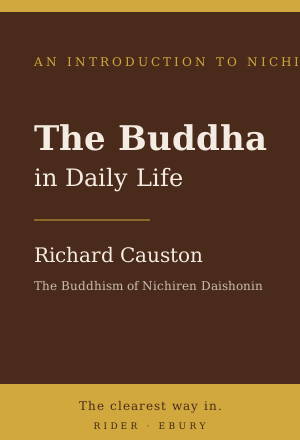
- Title
- The Buddha in Daily Life: An Introduction to the Buddhism of Nichiren Daishonin
- Author
- Richard Causton (1920–1995), former general director of SGI-UK
- Publisher
- Rider / Ebury (Penguin Random House), revised edition
- Length
- ~304 pp. (paperback)
- Difficulty
- Beginner ★☆☆ — about six hours
Check price & availability on the Amazon product page
What it is — in three lines
A general-reader introduction to the Buddhism that descends from Nichiren, written by Richard Causton, a longtime lay leader of the Soka Gakkai in Britain. It is not a life of Nichiren the medieval monk but an exposition of what his teaching means as a practice: the primacy of the Lotus Sutra, the chant of Nam-myoho-renge-kyo, and a Buddhist map of the human condition. Plain, patient, and pitched squarely at the newcomer.
The core — the doctrine made ordinary
Causton's real service is to take ideas that sound forbidding on the page and root them in everyday experience. The famous concept of the "ten worlds" or ten states of life — from hell and hunger through anger and tranquillity up to bodhisattva and buddhahood — is presented not as cosmology but as a description of the states we actually move through in a day, and of how practice is meant to shift them. Karma, the meaning of chanting, and the claim that buddhahood is available to anyone here and now are given the same down-to-earth treatment.
The point of the practice, on Causton's account, is not escape from daily life but the transformation of it from within.
— editorial summary of the book's theme
What makes it work as a first book is exactly this refusal to start with technical apparatus: you meet the ideas as lived before you ever meet them as doctrine.
Three highlights
1. Genuinely for beginners
No prior knowledge of Buddhism is assumed. Terms are introduced slowly and in plain language, which is why we place it at #1 — it is the least likely of the five to send a newcomer back.
2. Ideas grounded in experience
The ten states of life, karma, cause and effect — Causton keeps returning to ordinary situations, so the concepts arrive with something to hold onto rather than as abstractions.
3. A living tradition, not a museum piece
You come away understanding why Nichiren's Buddhism still has millions of practitioners, which the primary texts alone will not tell you. That context makes the letters and treatises that follow far easier to place.
What to watch out for
Two honest notes. First, this is an introduction from within the tradition, not a neutral or critical history. Causton writes as a committed practitioner and organisational leader, so read it as a sympathetic exposition of the faith, not as an impartial account of Nichiren the historical figure or of the debates around him. For that, you want the primary sources and, above all, Stone's scholarly study. Second, it is about the tradition as practised today more than about the thirteenth-century man; to meet Nichiren himself, go next to his letters. Used as Step 1 — a map before the territory — it is exactly right.
Check price & availability on the Amazon product page