Home › Top 5 › Letters of Nichiren
Review: Letters of Nichiren — the man in his own, human voice
★★★★★4.6 / 5.0 (editorial rating)
Verdict: the best primary text to read first. Where the treatises argue, the letters live. Written to ordinary followers facing illness, bereavement, poverty and persecution, they carry Nichiren's doctrine inside real human situations — consolation, courage, and the meaning of chanting the daimoku — in Burton Watson's clear translation. The most accessible door into Nichiren's own words.
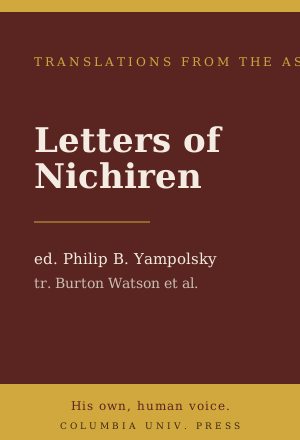
- Title
- Letters of Nichiren
- Author / Editor / Translator
- Nichiren; edited by Philip B. Yampolsky; translated by Burton Watson and others
- Publisher
- Columbia University Press (Translations from the Asian Classics)
- Length / Format
- ~544 pp. — hardcover
- Difficulty
- Intermediate ★★☆ — read selectively, not cover to cover
Check price & availability on the Amazon product page
What it is — in three lines
A generous selection of the letters Nichiren wrote to his lay followers, in the standard scholarly English translation from Columbia University Press. Edited by Philip B. Yampolsky and translated by Burton Watson and colleagues, it is the companion to the Selected Writings of treatises. Where the treatises are public arguments, the letters are personal — and that makes them the easiest of Nichiren's own words to enter.
The core — doctrine inside a life
Nichiren was one of the great letter-writers of medieval Japan, and the range here is the point. To a follower grieving a death he writes on impermanence and rebirth; to a samurai under pressure he writes on courage and the protection of the Lotus Sutra; to a woman he writes plainly on chanting Nam-myoho-renge-kyo and on the equal capacity of women for buddhahood. The abstractions of the doctrine — faith, karma, the Latter Day of the Law — keep arriving attached to a specific person in a specific difficulty.
Winter always turns to spring.
— a sentiment for which Nichiren's letters of encouragement are well known (rendered here as an editorial paraphrase; wording varies by translation)
The effect is that you understand the teaching as something meant to be used, which is exactly how Nichiren meant it, and exactly what a treatise cannot show you.
Three highlights
1. Nichiren at his most human
The fierce polemicist of the treatises is here a pastor: tender, practical, sometimes funny. It is the single best corrective to the caricature of Nichiren as only an angry sectarian.
2. Watson's translation
Burton Watson was among the finest translators of classical East Asian literature, and his Nichiren reads as English prose, not as decoded scholarship. The apparatus identifies recipients and occasions without burying the text.
3. Read it in any order
Because each letter is self-contained, you can dip in — start with the letters of encouragement and consolation — rather than reading front to back. That makes a 544-page volume far less daunting than it looks.
What to watch out for
Two honest notes. First, it is a hardcover from a university press, priced accordingly; check the product page, and note that this is a scholarly edition, not a cheap paperback. Second, the letters give you Nichiren's pastoral side but not the full architecture of his thought — for the sustained arguments (the establishment of the correct teaching, the opening of the eyes) you need the Selected Writings, and for the scripture underneath everything, the Lotus Sutra itself. This volume is the human core, not the whole system.
Check price & availability on the Amazon product page