NAGARJUNA BOOK GUIDE
The 5 Best Nāgārjuna Books (2026)
— emptiness and the middle way, in reading order
"All things are empty." Everyone has heard that Nāgārjuna — the second-century South Indian monk who founded the Madhyamaka school — taught the emptiness (śūnyatā) of everything, and almost everyone who tries to read him stalls in the same two places: they dive straight into the terse, relentless logic of the Mūlamadhyamakakārikā, and they mistake "emptiness" for "nothingness." Neither trap is necessary. Emptiness does not mean things do not exist; it means nothing has a fixed, independent essence — everything arises dependently. Meet that idea gently first, then read the root text with a translator's hand on your shoulder, then a second voice, and only then the hard philosophical study. Five books, in an order that actually works.
The editorial room behind this site runs a family of philosopher bookshelves and a section-by-section reading archive of the primary texts — every recommendation rests on first-hand reading, and every page here is honest about what each book is: a translation, a commentary, an introduction, or a philosophical monograph.
Our RankingRANKING
The editorial order. If you can't decide, start at #1. Check prices and availability on the Amazon product pages.
-
1
 If in doubt, start hereIntermediate
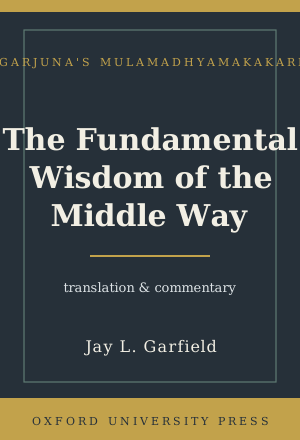
The Fundamental Wisdom of the Middle Way: Nāgārjuna's Mūlamadhyamakakārikā
The single most recommended way into Nāgārjuna in English: the complete root text of Madhyamaka, verse by verse, with Garfield's chapter-by-chapter commentary running alongside. Because the commentary carries you through the compressed logic — and links it to Hume, Sextus, and Wittgenstein — you get the primary text and a guide in one volume. The definitive first book.
Check price & availability on Amazon / Kindle edition available
View on Amazon Read on Kindle Read our review -
2
 Beginner
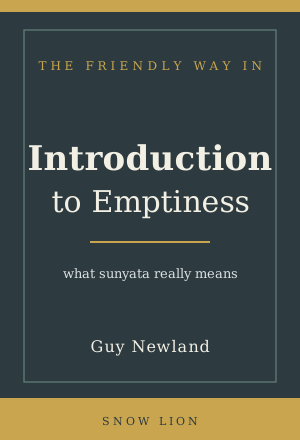
Introduction to Emptiness: As Taught in Tsong-kha-pa's Great Treatise on the Stages of the Path
The friendliest on-ramp to the one idea that stops most readers. Newland, a professor of religion, explains — in plain English, with everyday examples and no Sanskrit required — that emptiness is "not a mystical sort of nothingness" but a precise truth about how things exist dependently. Short and warm, it is the book to read before you open a single verse of the root text.
Check price & availability on Amazon / Kindle edition available
View on Amazon Read on Kindle Read our review -
3
 Intermediate
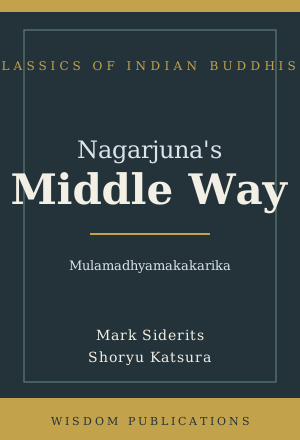
Nāgārjuna's Middle Way: Mūlamadhyamakakārikā
The same root text, in a second voice — and the one to read alongside or after Garfield. Siderits and Katsura translate from the four surviving Indian commentaries and add a crisp, analytic-philosophy exposition to every verse. Where Garfield reads the text through the Tibetan tradition, this prize-winning edition rebuilds the Indian arguments step by step. Reading a hard text in two translations is the fastest way to see what it actually says.
Check price & availability on Amazon / Kindle edition available
View on Amazon Read on Kindle Read our review -
4
 Advanced
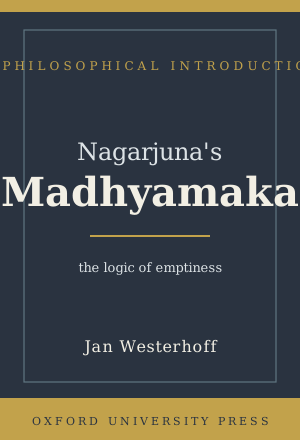
Nāgārjuna's Madhyamaka: A Philosophical Introduction
Once you know the text, this is the study that takes it seriously as philosophy. Westerhoff, now professor of Buddhist philosophy at Oxford, reconstructs Madhyamaka as a rigorous system — what "emptiness of emptiness" means, how Nāgārjuna can deny all positions without contradiction, whether he is a sceptic, a mystic, or something stranger. Demanding, but the clearest map of the arguments as arguments.
Check price & availability on Amazon / Kindle edition available
View on Amazon Read on Kindle Read our review -
5
 Advanced
Nāgārjuna's Precious Garland: Buddhist Advice for Living and Liberation
Nāgārjuna's other voice. Beyond the austere logic of the Mūlamadhyamakakārikā, the Ratnāvalī ("Precious Garland") offers counsel on how to live and how to govern — emptiness turned toward ethics and even statecraft. Hopkins' translation, with an account of Nāgārjuna's life and themes, shows that the philosopher of emptiness was also a moralist. The book that rounds out the picture the root text alone can't give.
Check price & availability on Amazon
View on Amazon Read our review
The 5 Books at a GlanceCOMPARE
The biggest worry with Nāgārjuna is "can I follow the argument about emptiness?" Choose by difficulty and by what each book actually is — an introduction, a translation, or a study.
| Title | Difficulty | Length | Type | Best for | Links |
|---|---|---|---|---|---|
| The Fundamental Wisdom of the Middle Waytr. Garfield · Oxford | Intermediate ★★☆ | ~370 pp. 2–4 weeks |
Primary text + commentary | You want the root text with a guide built in | View on Amazon Review |
| Introduction to EmptinessGuy Newland · Snow Lion | Beginner ★☆☆ | ~144 pp. ~4 hrs |
Accessible introduction | You want to understand "emptiness" before any verse | View on Amazon Review |
| Nāgārjuna's Middle WaySiderits & Katsura · Wisdom | Intermediate ★★☆ | ~368 pp. 2–4 weeks |
Primary text + analytic exposition | You want the verses in a second, Indian-commentary voice | View on Amazon Review |
| Nāgārjuna's MadhyamakaJan Westerhoff · Oxford | Advanced ★★★ | ~256 pp. 3–5 weeks |
Philosophical study | You want the arguments rebuilt as rigorous philosophy | View on Amazon Review |
| Nāgārjuna's Precious Garlandtr. Hopkins · Snow Lion | Advanced ★★★ | ~288 pp. 2–3 weeks |
Primary text (other work) | You want Nāgārjuna on ethics and living, beyond the logic | View on Amazon Review |
A Reading Order That Won't Defeat YouROADMAP
Two things sink most first readers of Nāgārjuna: opening the Mūlamadhyamakakārikā cold, and hearing "emptiness" as "nothingness." Emptiness is not nihilism — it is the claim that nothing has an independent essence because everything arises in dependence. Meet the idea gently, read the root text with a guide, hear a second voice, then take on the philosophy. Climb in four steps.
-
STEP 1 ── Understand "emptiness" first (one short book)
Read Newland's Introduction to Emptiness
Before a single verse, spend an afternoon with Newland's plain-English account of what emptiness is and — just as important — what it is not. Get "no independent essence, everything dependent" firmly in mind, and the root text stops looking like paradox-mongering and starts looking like argument.
Introduction to Emptiness on Amazon -
STEP 2 ── Read the root text with a hand to hold (the core)
Work through Garfield's Fundamental Wisdom of the Middle Way
Now open the Mūlamadhyamakakārikā itself — but in the edition where a commentary runs beside every verse. Garfield's chapter-by-chapter gloss keeps you from drowning in the compressed logic and shows how each argument dismantles a claim to independent existence. This is the centre of the shelf; give it real time.
Fundamental Wisdom on Amazon -
STEP 3 ── Hear a second voice (deepen)
Re-read the verses in Siderits & Katsura's Middle Way
The surest way to understand a difficult text is to read it in two translations. Siderits and Katsura rebuild the same verses from the Indian commentaries in a spare, analytic style. Where Garfield gives you the Tibetan reading, they give you the Indian arguments — and the differences are where the real understanding happens.
Nāgārjuna's Middle Way on Amazon -
STEP 4 ── Take on the philosophy, and the other Nāgārjuna (the goal)
Study Westerhoff's Madhyamaka, then read the Precious Garland
With the text in hand, Westerhoff's monograph rebuilds Madhyamaka as a rigorous philosophical system — the hardest and most rewarding book here. Then let the Precious Garland, in Hopkins' translation, show you the other Nāgārjuna: emptiness turned toward how to live and how to govern. Finish these and you can hold the whole thinker in view.
Westerhoff's Madhyamaka on AmazonRead our Precious Garland review
How We ChoseCRITERIA
Three criteria. First, currently in print and actually available on amazon.com — every title has a live product page from an established academic or Buddhist publisher (Oxford University Press, Wisdom Publications, Snow Lion). Second, the ladder must hold: understand emptiness → read the root text with a guide → hear a second translation → take on the philosophy and the other works, each step preparing the next. Third, honesty about what each book is and about the one hard fact: Nāgārjuna's Mūlamadhyamakakārikā is terse verse whose meaning is genuinely contested, and every translation reads it through a tradition — Garfield through the Tibetan commentaries, Siderits and Katsura through the Indian ones. The reviews say which, and never pretend a translation is a neutral transcript. The editorial room runs a family of philosopher bookshelves and a section-by-section archive of the primary texts; those first-hand readings are the foundation here.
Still Undecided? Take This OneCONCLUSION
If you have read this far and still can't choose, the answer is simple: buy Garfield's The Fundamental Wisdom of the Middle Way. It is the rare book that is both the primary text and its own guide — the complete Mūlamadhyamakakārikā with a commentary that carries you through the hardest verses. If even that feels daunting, spend an afternoon with Newland's Introduction to Emptiness first and come back.
Check price & availability on the Amazon product pages