Home › Top 5 › Fundamental Wisdom of the Middle Way
Review: The Fundamental Wisdom of the Middle Way — the root text with a guide built in
★★★★★4.6 / 5.0 (editorial rating)
Verdict: if you buy one Nāgārjuna book, buy this one. Garfield gives you the whole Mūlamadhyamakakārikā — the founding text of Madhyamaka — and then walks beside you through it, verse by verse. The commentary is what makes the compressed logic survivable: the primary source and its guide, bound together.
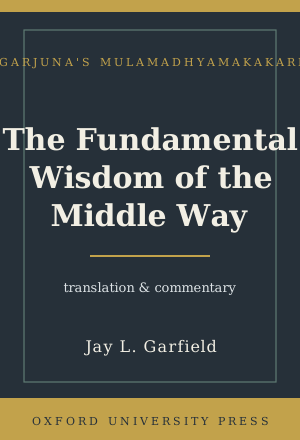
- Title
- The Fundamental Wisdom of the Middle Way: Nāgārjuna's Mūlamadhyamakakārikā
- Author
- Nāgārjuna; translated with commentary by Jay L. Garfield
- Publisher
- Oxford University Press (1995)
- Length
- ~370 pp.
- Difficulty
- Intermediate ★★☆ — two to four weeks
Check price & availability on the Amazon product page
What it is — in three lines
A complete English translation of Nāgārjuna's Mūlamadhyamakakārikā ("Fundamental Verses on the Middle Way"), the root text of the Madhyamaka school, by Jay L. Garfield, published by Oxford University Press in 1995. It is not a bare translation but a translation with a running commentary: Garfield sets out the twenty-seven chapters verse by verse and explains, in plain philosophical English, what each argument is doing. His reading follows the Tibetan tradition through which Nāgārjuna's influence was largely transmitted.
The core — a translation that teaches
The Mūlamadhyamakakārikā is famously hard: a few hundred terse verses that dismantle, one after another, the idea that anything — motion, time, the self, cause and effect, even the Buddha's teaching — has a fixed, independent essence (svabhāva). Read cold, it can feel like a machine for producing paradoxes. Garfield's achievement is to make the machinery visible. He shows that each chapter takes some candidate for "something with its own being" and argues that, examined closely, it turns out to be empty — dependent, relational, without a core — and that this emptiness is itself the middle way between saying things exist absolutely and saying they do not exist at all.
Whatever is dependently co-arisen, that is explained to be emptiness. That, being a dependent designation, is itself the middle way.
— Nāgārjuna, Mūlamadhyamakakārikā 24.18 (standard sense of the verse; editorial gloss)
Because the commentary also reaches sideways — to Hume on causation, to the Greek sceptics, to Wittgenstein — a reader trained in Western philosophy is given handholds at every difficult turn. That is what earns this edition its place at the top of the shelf.
Three highlights
1. Commentary on the same page as the verse
You never face a bare verse alone. Translation and explanation sit together, so the moment a line looks impossible, the gloss is right there. It is the difference between reading Nāgārjuna and being taught him.
2. The whole text, not selections
All twenty-seven chapters are here, in order. You see the argument build — from conditions and motion to the self, time, and nirvāṇa — rather than a curated set of highlights, which matters for a thinker whose case is cumulative.
3. A bridge to Western philosophy
Garfield deliberately renders Nāgārjuna's concerns in the vocabulary of Western metaphysics and epistemology. For most English-speaking readers that bridge is what turns an alien text into a live philosophical argument.
What to watch out for
Two honest notes. First, this is a reading of the text, not the only one. Garfield works largely through the Tibetan (Gelukpa) commentarial tradition; other scholars read some verses differently, and specialists have debated his interpretation. That is not a flaw — it is the nature of a contested text — but it is why we pair it with Siderits and Katsura's translation from the Indian commentaries. Second, "Intermediate" is honest: even with the commentary, this is real philosophy and rewards slow reading. If "emptiness" is still a fog, read Newland's Introduction to Emptiness first — an afternoon there makes this book far easier.
Check price & availability on the Amazon product page