Home › Top 5 › Nāgārjuna's Middle Way
Review: Nāgārjuna's Middle Way — the root text in a second, analytic voice
★★★★☆4.5 / 5.0 (editorial rating)
Verdict: the best companion to Garfield — and, for some readers, the better single volume. Siderits and Katsura translate the Mūlamadhyamakakārikā from the surviving Indian commentaries and gloss every verse in spare, analytic English. Read the same text in two translations and you finally see past the words to the argument.
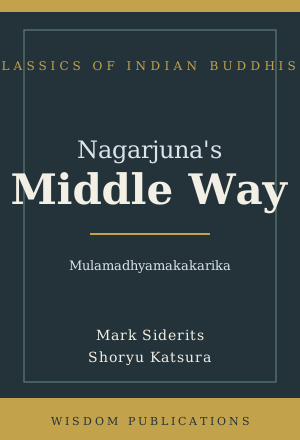
- Title
- Nāgārjuna's Middle Way: Mūlamadhyamakakārikā (Classics of Indian Buddhism)
- Author
- Nāgārjuna; translated by Mark Siderits & Shōryū Katsura
- Publisher
- Wisdom Publications (2013)
- Length
- ~368 pp.
- Difficulty
- Intermediate ★★☆ — two to four weeks
Check price & availability on the Amazon product page
What it is — in three lines
A complete translation of Nāgārjuna's Mūlamadhyamakakārikā by Mark Siderits (a philosopher long associated with analytic readings of Buddhist thought) and Shōryū Katsura (a leading scholar of Indian Buddhist logic), published by Wisdom Publications in 2013 in the Classics of Indian Buddhism series. The translators worked from the four surviving Indian commentaries, and each verse is followed by a concise exposition that conveys how those Indian commentators understood it. It won the 2014 Khyentse Foundation Translation Prize.
The core — reconstructed from the Indian commentaries
What sets this edition apart is its route to the text. Rather than reading Nāgārjuna primarily through the later Tibetan tradition, Siderits and Katsura reconstruct each verse from the Indian commentarial literature that grew up closest to it, and then restate the argument in the clean, step-by-step idiom of analytic philosophy. The result reads almost like a logic seminar: premises, moves, and conclusions laid bare. Where Garfield gives you a flowing commentary, this gives you the skeleton of the reasoning — and for a text whose whole force is argumentative, that clarity is a gift.
Neither from itself nor from another, nor from both, nor without a cause, does anything whatever, anywhere arise.
— Nāgārjuna, Mūlamadhyamakakārikā 1.1 (standard sense of the opening verse; editorial gloss)
Set this rendering beside Garfield's and the differences — a word here, an emphasis there — become an education in what the verse is actually claiming.
Three highlights
1. Exposition on every verse
No verse stands unexplained. The commentary is compact but genuinely argumentative, tracking the Indian commentators' reasoning rather than paraphrasing the poetry.
2. The Indian route, not only the Tibetan
Reading the text through its earliest surviving commentaries is a different and valuable angle, and the natural counterweight to Garfield's Tibetan-inflected reading.
3. Analytic clarity
Siderits' training shows: the arguments are set out as arguments, which suits readers who want to test each move rather than absorb an atmosphere.
What to watch out for
Two honest notes. First, the analytic style is a choice, not neutrality. Rendering Nāgārjuna in the vocabulary of contemporary logic makes the reasoning vivid but inevitably frames it in one modern idiom; that is exactly why we recommend reading it with Garfield rather than instead of him. Second, despite the accessible packaging, this is not a first book on emptiness — the exposition assumes you want to follow arguments closely. If the concept itself is still hazy, start with Newland, then come here to see the arguments in the sharpest possible light.
Check price & availability on the Amazon product page