Home › Top 5 › Introduction to Emptiness
Review: Introduction to Emptiness — the friendliest way into śūnyatā
★★★★☆4.4 / 5.0 (editorial rating)
Verdict: the single best on-ramp to the idea that stops most readers. In about a hundred and forty warm, plain-spoken pages, Newland gets one thing firmly into your head — emptiness is not nothingness — and that alone makes everything else on this shelf twice as readable.
- Title
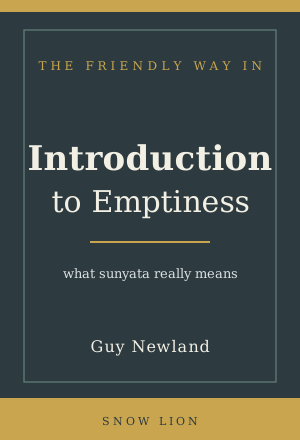
- Introduction to Emptiness: As Taught in Tsong-kha-pa's Great Treatise on the Stages of the Path
- Author
- Guy Newland (Professor of Religion, Central Michigan University)
- Publisher
- Snow Lion (2008; expanded ed. 2009)
- Length
- ~144 pp.
- Difficulty
- Beginner ★☆☆ — about four hours
Check price & availability on the Amazon product page
What it is — in three lines
A short, accessible introduction to the Buddhist idea of emptiness by Guy Newland, a professor of religion who has spent a career teaching this material. It follows the treatment of emptiness in one of the great classics of the Tibetan tradition — Tsong-kha-pa's Great Treatise on the Stages of the Path — but translates it into everyday English with contemporary examples, so no Sanskrit, Tibetan, or prior philosophy is assumed. It is a primer on the concept, not a study of Nāgārjuna's text.
The core — emptiness is not nothingness
The single most common mistake a new reader makes is to hear "all things are empty" as "nothing really exists" — a bleak nihilism. Newland's whole book is built to prevent that error. Emptiness, he insists, is "not a mystical sort of nothingness" but a precise and arguable truth: things exist, but not in the independent, self-sufficient way we unreflectively assume. A chariot, a self, a table — each exists only in dependence on parts, causes, and concepts, and it is that lack of independent essence which "empty" names.
Emptiness is not a mystical sort of nothingness, but a specific truth that can and must be understood through calm and careful reflection.
— the theme of Newland's Introduction to Emptiness (editorial paraphrase)
Get this straight, and Nāgārjuna's relentless verses stop sounding like word-games and start sounding like what they are: a careful argument that dependent existence is the only kind there is.
Three highlights
1. Plain language, real examples
Newland reaches for cars, tables, and ordinary situations rather than technical vocabulary. The abstractions land because they are attached to things you can picture.
2. Short enough to finish in an afternoon
At around 140 pages it is a genuine primer, not a treatise. You can read it before you commit to any of the harder books and lose nothing but an afternoon.
3. Anchored in a real classic
Because it follows Tsong-kha-pa's Great Treatise, the accessibility never tips into vagueness — the everyday examples are illustrating a rigorous traditional account, not replacing it.
What to watch out for
Two honest notes. First, this is not a book about Nāgārjuna's text. It teaches the concept of emptiness through the later Tibetan (Gelukpa) synthesis; you will not find the Mūlamadhyamakakārikā read verse by verse here — that is the job of Garfield and Siderits and Katsura. Second, it presents a particular tradition's settled interpretation of emptiness rather than surveying the scholarly debates; treat it as the clearest possible on-ramp, not the last word. Used that way — first, and fast — it is close to indispensable.
Check price & availability on the Amazon product page