LEIBNIZ BOOK GUIDE
The 5 Best Leibniz Books (2026)
— from the Monadology to the New Essays, in reading order
You picked up Leibniz, hit the line about the "windowless monad" that mirrors the whole universe from within, and quietly put it down again. Almost everyone does. Leibniz is hard — but the usual reason people stall is starting cold with a primary text and no map. There is a staircase. First a short introduction that lays out monads, pre-established harmony and the best of all possible worlds; then the Monadology and the Discourse on Metaphysics in his own words; then the fuller reader; and finally the two big works. Five real English editions, ordered by difficulty rather than by date.
The editorial room behind this site runs a family of philosopher bookshelves and a section-by-section reading archive of the primary texts (in Japanese) — including a Japanese edition of this very shelf. Every recommendation rests on first-hand reading. One honest heads-up up front: two of the five books (the slim Hackett Discourse and the larger Philosophical Essays) overlap in content — the roadmap below tells you which one to buy so you don't pay twice for the same texts.
Our RankingRANKING
The editorial order. If you can't decide, start at #1. Check prices and availability on the Amazon product pages.
-
1
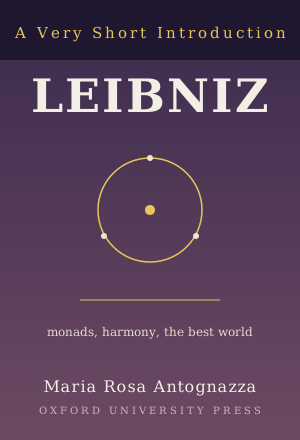 If in doubt, start hereBeginner
Leibniz: A Very Short Introduction
The single best entry point. Antognazza — author of the standard scholarly biography — compresses Leibniz's vast system into about 140 pages: monads, pre-established harmony, the best of all possible worlds, the response to evil, and the logic and mathematics behind them. Read this first and every later primary text has somewhere to land.
Check price & availability on Amazon / Kindle edition available
View on Amazon Read on Kindle Read our review -
2
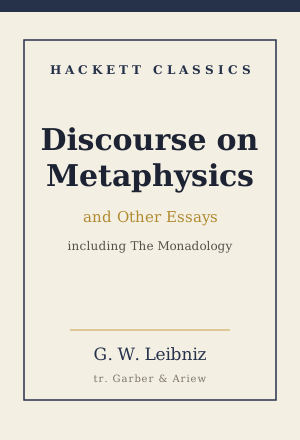 Intermediate (primary)
Discourse on Metaphysics and Other Essays
The best short way into Leibniz's own words. This slim, inexpensive Hackett volume pairs the two most important short works — the Discourse on Metaphysics (the framework of the system) and the Monadology (that system in 90 numbered sections) — with a handful of other key pieces. Small enough to finish in a weekend, dense enough to hold the whole metaphysics.
Check price & availability on Amazon / Kindle edition available
View on Amazon Read on Kindle Read our review -
3
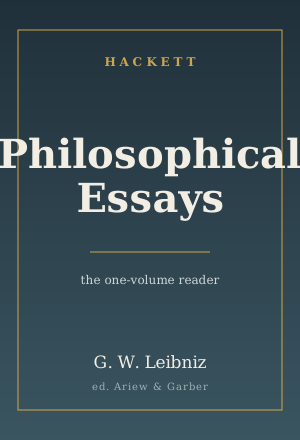 Intermediate (reader)
Philosophical Essays
The standard one-volume reader by the same editors, and the natural home base for reading Leibniz in English. It reprints the Discourse and the Monadology and adds far more — the correspondence with Arnauld and Clarke, the essays on truth and contingency, "On the Ultimate Origination of Things." It overlaps with #2, so pick one: the slim volume to sample, this reader to settle in.
Check price & availability on Amazon / Kindle edition available
View on Amazon Read on Kindle Read our review -
4
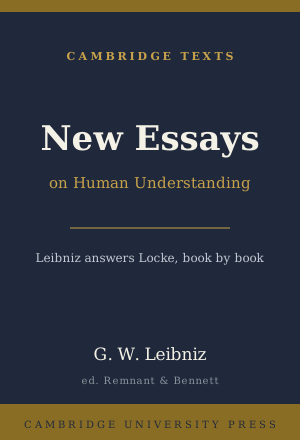 Advanced (major work)
New Essays on Human Understanding
Leibniz's book-length reply to Locke, set out chapter by chapter against the Essay Concerning Human Understanding. Against Locke's mind-as-blank-slate, Leibniz argues the soul comes with innate tendencies — the great head-on meeting of Continental rationalism and British empiricism. Written as a dialogue between "Philalethes" (Locke) and "Theophilus" (Leibniz), so it reads more easily than its size suggests, but it is the toughest climb on the shelf.
Check price & availability on Amazon
View on Amazon Read our review -
5
 Advanced (biography)
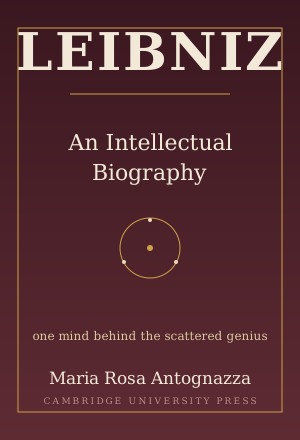
Leibniz: An Intellectual Biography
The capstone: the definitive modern life. Antognazza follows Leibniz across philosophy, mathematics, law, theology, history and diplomacy, and shows that the scattered genius — calculus, the monads, the dream of a universal logic — was driven by one unifying vision. Long, but narrative and readable. The book that turns a list of doctrines into a single mind.
Check price & availability on Amazon / Kindle edition available
View on Amazon Read on Kindle Read our review
The 5 Books at a GlanceCOMPARE
The biggest worry with Leibniz is "can I actually finish this?" — and, once you decide to read the short works, "the slim Hackett Discourse or the bigger Philosophical Essays?" Choose by difficulty, length, and content overlap.
| Title | Difficulty | Length | Type | Best for | Links |
|---|---|---|---|---|---|
| Leibniz: A Very Short IntroductionAntognazza · Oxford UP | Beginner ★☆☆ | ~144 pp. ~3 hrs |
Scholarly introduction | Trying Leibniz for the first time; you want the map before the maze | View on Amazon Review |
| Discourse on Metaphysics and Other Essaystr. Garber & Ariew · Hackett | Intermediate ★★☆ | ~102 pp. ~1 weekend |
Primary (short works + Monadology) | Reading Leibniz's own words for the first time, cheaply | View on Amazon Review |
| Philosophical Essaysed. Ariew & Garber · Hackett | Intermediate ★★☆ | ~384 pp. ~2 weeks |
Primary reader (superset of #2) | Settling in with the standard English reader ※ overlaps with #2 |
View on Amazon Review |
| New Essays on Human Understandinged. Remnant & Bennett · Cambridge | Advanced ★★★ | ~528 pp. 3–4 weeks |
Primary (major work) | Taking on the reply to Locke, argument by argument | View on Amazon Review |
| Leibniz: An Intellectual BiographyAntognazza · Cambridge UP | Advanced ★★★ | ~652 pp. 3–4 weeks |
Biography / study | Seeing the whole mind behind the scattered genius | View on Amazon Review |
Avoiding a double purchase: the short works are in both #2 and #3. To read the Discourse and the Monadology, either take (A) the slim Hackett Discourse on Metaphysics and Other Essays — cheap, and enough to sample — or (B) the larger Philosophical Essays, which contains those same texts plus the Arnauld and Clarke correspondence and much more. You do not need both. Choose (A) to test the water, (B) to make a home.
A Reading Order That Won't Defeat YouROADMAP
The two ways people stall with Leibniz are opening a primary text cold, with no map, and trying to memorise terms like monad, pre-established harmony and best possible world as dictionary entries. Introduction → short primary → fuller reader → the major works. Four steps.
-
STEP 1 ── Get the map (one short book)
Antognazza's Very Short Introduction for the whole system
Don't dive into a primary text first. In about 140 pages you can hold the entire framework — monads, pre-established harmony, the best of all possible worlds — so that when an abstract term turns up in Leibniz's own writing, you already know where it sits on the map.
Very Short Introduction on Amazon -
STEP 2 ── Read him short (his own words)
The Discourse on Metaphysics and the Monadology
With the map in hand, meet Leibniz himself. The Monadology states his whole cosmology in 90 short sections; the Discourse lays out its foundations. The slim Hackett Discourse on Metaphysics and Other Essays gives you both in one weekend-sized volume — the success of finishing one short primary text makes everything afterwards lighter.
Discourse & Monadology on Amazon -
STEP 3 ── Settle in (choose one, mind the overlap)
The Philosophical Essays reader, if you want more
If the short works leave you wanting the wider picture — the debates with Arnauld and Clarke, the essays on truth and contingency — move up to the Philosophical Essays. Here is the one choice on this shelf: it already contains the Discourse and the Monadology, so use the fuller reader instead of the slim volume, not as well as it. One or the other is enough.
Philosophical Essays on Amazon -
STEP 4 ── The major works (the goal)
The New Essays for the argument, the biography for the life
Now for the summit. The New Essays on Human Understanding is Leibniz's chapter-by-chapter answer to Locke — the toughest but, as a dialogue, more readable than it looks. And when you want the whole mind rather than a single work, Antognazza's Intellectual Biography ties calculus, logic, law and the monads into one vision. Finish either and you can describe Leibniz's reach in your own words.
New Essays on AmazonThe biography on Amazon
How We ChoseCRITERIA
Five criteria. First, currently in print and actually available on amazon.com — every title has a live product page from an established publisher (Oxford University Press, Hackett, Cambridge University Press). Second, the ladder must hold: introduction → short primary → fuller reader → major works, each step preparing the next. Third, real English editions only: Leibniz wrote in Latin and French, so we chose the standard scholarly translations — Garber & Ariew's Hackett volumes, the Remnant & Bennett Cambridge New Essays — rather than dated public-domain texts. Fourth, honesty about overlap: the slim Hackett Discourse and the larger Philosophical Essays share texts, so we say plainly that you need only one. Fifth, each book's role is named in its review — introduction, primary source, or biography — with its hard passages flagged. The editorial room runs a family of philosopher bookshelves and a section-by-section archive of the primary texts (in Japanese); those first-hand readings are the foundation here.
Still Undecided? Take This OneCONCLUSION
If you have read this far and still can't choose, the answer is simple: start with Antognazza's Leibniz: A Very Short Introduction. Leibniz's system is unusual, and diving into a primary text without a map defeats most readers. Get the picture of monads, pre-established harmony and the best of all possible worlds from this short book first, and the Monadology suddenly comes within reach. After that, read the short works — and to read them, remember you need only one of the two Hackett volumes, not both.
Check price & availability on the Amazon product pages