Home › Top 5 › Discourse & Monadology
Review: Discourse on Metaphysics and Other Essays — the Monadology in your own hands
★★★★★4.6 / 5.0 (editorial rating)
Verdict: the best short way to read Leibniz's own words. This slim, cheap Hackett volume gives you the two texts that matter most — the Discourse on Metaphysics, which lays the foundations, and the Monadology, which states the whole cosmology in 90 short sections — plus a few other key pieces. It is small enough to finish in a weekend and, read after the introduction, it is where "the windowless monad" stops being a slogan and starts making sense.
- Title
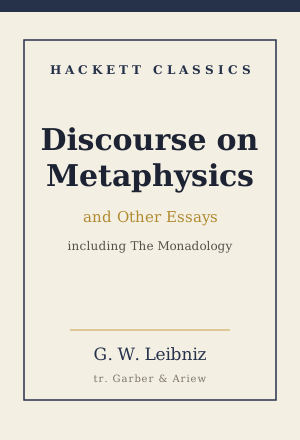
- Discourse on Metaphysics and Other Essays
- Author
- G. W. Leibniz, tr. Daniel Garber & Roger Ariew
- Publisher
- Hackett Publishing (1991; texts of the 1680s–1710s)
- Length
- Primary source · ~102 pp.
- Difficulty
- Intermediate ★★☆ — short, but genuine philosophy
Check price & availability on the Amazon product page
What it is — in three lines
Leibniz never published a single great book of his system; he left it scattered across short works, essays and letters. This Hackett volume, translated by Daniel Garber and Roger Ariew — two of the leading editors of Leibniz in English — gathers the most important of the short pieces. At its centre are the Discourse on Metaphysics (1686), the first full statement of his framework, and the Monadology (1714), the late, compressed summary of the whole cosmology. It is the compact, affordable way to read Leibniz himself.
The core — the system in 90 sections
The Monadology is the reason this book earns its place. In just ninety short numbered paragraphs Leibniz states his entire picture of reality: the world is made of monads, simple substances with no parts; each is "windowless," changing only from its own internal principle; and each is a living mirror of the whole universe from a unique point of view. Because the mirrors never collide, there must be a pre-established harmony set up by God, who chose this world as the best of all the possible ones. The Discourse on Metaphysics supplies the ground beneath that summary — including the striking thesis that every individual substance has a complete concept containing all its predicates, so that, in a sense, everything that will ever happen to you is already "written into" the concept of you. Read together, the short foundation and the compressed summit let you see the same system from two heights.
Three highlights
1. A whole cosmology you can hold in one sitting
Very few primary texts in metaphysics are this short. The Monadology's ninety sections mean you can read the entire system in an evening and then reread it — and rereading, section against section, is where it opens up.
2. The scholar's standard translation
Garber and Ariew's renderings are the ones used in university courses for a reason: careful, current, and consistent with the larger Philosophical Essays by the same editors. You are reading Leibniz in the translation the field trusts.
3. The bridge from map to text
After Antognazza's introduction, this is the moment the abstract terms become sentences Leibniz actually wrote. Checking "windowless monad" or "best of all possible worlds" against the source is the success that makes every later, longer work feel lighter.
What to watch out for
Two honest notes. First, "short" is not "easy": the Monadology's compression means each section rewards slow, repeated reading rather than a single pass — come to it after the introduction, not before. Second, and this governs the whole shelf: this slim volume overlaps with the larger Philosophical Essays, which reprints both the Discourse and the Monadology and adds much more. If you already know you will want the correspondence with Arnauld and Clarke and the essays on truth, buy the bigger reader instead — not as well. This one is the low-cost way to sample; the Philosophical Essays is the way to settle in. You do not need both.
Check price & availability on the Amazon product page