Review: New Essays on Human Understanding — Leibniz answers Locke, chapter by chapter
★★★★☆4.5 / 5.0 (editorial rating)
Verdict: the toughest climb on the shelf, and one of the great confrontations in the history of philosophy. Leibniz wrote this book-length reply to Locke's Essay Concerning Human Understanding, following it chapter by chapter. Against Locke's mind as a blank slate, he argues the soul comes furnished with innate tendencies — Continental rationalism meeting British empiricism head-on. It is long, but written as a dialogue, so it moves more easily than its size suggests. Save it for after the short works.
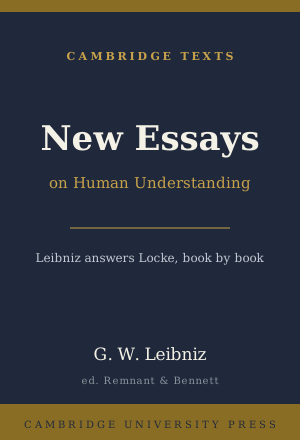
- Title
- New Essays on Human Understanding
- Author
- G. W. Leibniz, ed. Peter Remnant & Jonathan Bennett
- Publisher
- Cambridge University Press (Cambridge Texts, 1996; written c. 1704)
- Length
- Primary source · ~528 pp.
- Difficulty
- Advanced ★★★ — a full-length work; give it weeks
Check price & availability on the Amazon product page
What it is — in three lines
Around 1704 Leibniz worked through John Locke's Essay Concerning Human Understanding and wrote a reply that mirrors it book for book and chapter for chapter. He never published it — Locke died while it was being written, and Leibniz set it aside — so it appeared only after his death, which is part of why it reads as such a candid working-out of his views. This Cambridge Texts edition, edited and translated by Peter Remnant and Jonathan Bennett, is the standard scholarly English version, with the apparatus a work this dense needs.
The core — innate ideas against the blank slate
The whole book turns on a single disagreement. Locke held that the mind at birth is a blank sheet — tabula rasa — on which experience alone writes; there are no innate ideas. Leibniz answers with one of philosophy's famous images: the mind is not a blank tablet but a block of veined marble, whose veins already incline it toward some shapes rather than others. Nothing is in the intellect, he grants, that was not first in the senses — except the intellect itself. Experience awakens what the mind was already disposed to think; it does not write on nothing. From this root the two thinkers divide over the nature of knowledge, necessity, substance and personal identity, chapter after chapter — which is why the New Essays is read as the monument where seventeenth-century rationalism and empiricism finally face each other in full.
Three highlights
1. The dialogue form
Leibniz stages the whole book as a conversation between Philalethes, who speaks for Locke, and Theophilus, who speaks for Leibniz. That format keeps a 500-page treatise surprisingly light: you always know which position is on the table and why, and the back-and-forth carries you along.
2. The marble-vein image
The reply to the blank slate is stated so vividly that it has outlived the debate that prompted it. It is the single passage most worth reading slowly, and the one that best repays the whole climb.
3. Leibniz across the whole of knowledge
Because he follows Locke everywhere, the book ranges over perception, language, mathematics, morality and identity. It is the nearest thing Leibniz left to a sustained, full-length statement — the closest he came to the systematic treatise he never wrote.
What to watch out for
Be honest with yourself about the size. This is a full-length primary work of some five hundred pages, and although the dialogue form eases the way, the argument sections have real bone in them — the discussions of necessity, substance and identity demand time and attention. Two defences. First, come to it last, after the introduction and the short works; the reading order on this shelf is built to bring you here prepared. Second, it genuinely helps to have Locke's Essay in view, since the book is a running response to it — even a summary of Locke's chapter headings will make Leibniz's replies land. If a stretch of argument stalls you, follow the dialogue's own thread and circle back; it is designed to be read as an exchange, not decoded line by line.
Check price & availability on the Amazon product page