Home › Top 5 › Intellectual Biography
Review: Leibniz: An Intellectual Biography — the whole mind, at last
★★★★★4.6 / 5.0 (editorial rating)
Verdict: the capstone of the shelf. Maria Rosa Antognazza's is the definitive modern life of Leibniz, and it does the one thing the primary texts cannot: it shows how the calculus, the logic, the law, the theology and the monads all belonged to a single unifying vision. Leibniz can look like a dozen brilliant part-time projects; this book proves he was one project. Long, but narrative and readable — the volume that turns a list of doctrines into a person.
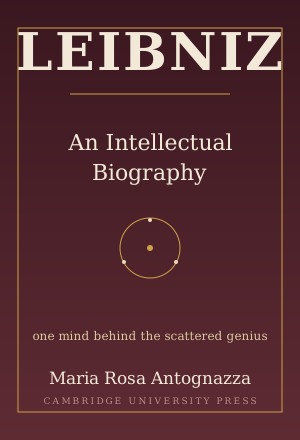
- Title
- Leibniz: An Intellectual Biography
- Author
- Maria Rosa Antognazza
- Publisher
- Cambridge University Press (paperback 2011; first published 2009)
- Length
- Biography / study · ~652 pp.
- Difficulty
- Advanced ★★★ — long, but narrative prose
Check price & availability on the Amazon product page
What it is — in three lines
Maria Rosa Antognazza, who also wrote this shelf's short introduction, spent years in the archives to produce the first full intellectual biography of Leibniz in English on this scale. It follows him from Leipzig to Hanover and across an astonishing range of activity — philosophy, mathematics, physics, jurisprudence, theology, history, engineering, diplomacy — and reads the ideas in the light of the life. Where a primary text gives you one facet, this gives you the whole figure.
The core — one vision behind many works
The problem with Leibniz is that he seems to be everywhere at once: co-inventor of the calculus, designer of a calculating machine, dreamer of a universal logical language, author of the monads, working librarian, historian and diplomat. It is tempting to treat him as a scatter of unrelated talents. Antognazza's governing argument is that this is an illusion — that behind the dispersion lay a single, lifelong project: a rational reform and unification of all knowledge, in the service of what he saw as the harmony of the whole. The dream of a "universal characteristic" that could settle disputes by calculation, the metaphysics of monads mirroring one another in pre-established harmony, the effort to reconcile the divided churches — these were not hobbies beside the philosophy but expressions of the same aim. Reading the philosophy this way, as one movement of a single mind, changes how the doctrines land: the best of all possible worlds is not an isolated claim but the theological face of the same vision that drove the logic and the mathematics.
Three highlights
1. The unifying thesis
The claim that Leibniz's scattered genius sprang from one vision is stated at introductory length in the Very Short Introduction and proved here at full length, across the whole life. Having read the short works first, you feel the argument close.
2. Archival authority
Leibniz left a vast, still-being-edited mass of manuscripts and letters. Antognazza works from that record, which is why the book has become the standard reference — it is grounded in the sources, not in legend.
3. A life that reads like one
Despite its scholarly weight, it is written as a narrative, with a real sense of period and person. For a book of its size and rigour, it turns pages more readily than you expect.
What to watch out for
Two things. First, this is not an introduction and not a primary text — it is a full biography of over six hundred pages, and it assumes you actually want the life and the context. Read cold, before you know the Monadology, much of its detail would have nowhere to land; that is exactly why it sits last on this shelf, as the capstone rather than the doorway. Second, a biography is a reading of a life, an argument for how to see Leibniz whole — a superb one, but still an interpretation. Treat its unifying thesis as an illuminating case to think with, and keep your own copy of the primary texts within reach to check the ideas against the source.
Check price & availability on the Amazon product page