Home › Top 5 › A Very Short Introduction
Review: Leibniz: A Very Short Introduction — the gentlest way into the monads
★★★★★5.0 / 5.0 (editorial rating)
Verdict: if you read only one book about Leibniz, read this one. In about 140 pages Maria Rosa Antognazza — who wrote the standard scholarly biography — sets out the entire system: monads, pre-established harmony, and the best of all possible worlds. It is short enough for an afternoon yet leaves you with a map you can carry into every primary text. There is no better place to stand before you open the Monadology.
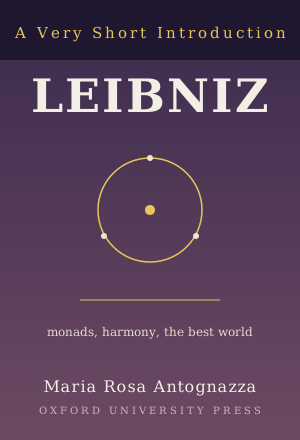
- Title
- Leibniz: A Very Short Introduction
- Author
- Maria Rosa Antognazza
- Publisher
- Oxford University Press (2016)
- Length
- Introduction · ~144 pp.
- Difficulty
- Beginner ★☆☆ — readable from zero background
Check price & availability on the Amazon product page
What it is — in three lines
This is a short introduction by Maria Rosa Antognazza, Professor of Philosophy at King's College London and the author of the definitive Leibniz: An Intellectual Biography. Written for Oxford's Very Short Introductions series, it does what that series does best: distil the heart of one thinker into a genuinely small book. Its aim is to give a first-time reader the whole shape of Leibniz's philosophy — and the vision that held its many parts together — before a single primary text is opened.
The core — from one universe to many mirrors
For Leibniz the world is built out of countless simple substances that cannot be divided any further — monads. A monad is "windowless": nothing enters it from outside; instead each one unfolds from within, like a mirror reflecting the entire universe from its own single point of view. Every monad reflects the same world, but each reflects it differently. Antognazza uses that idea to make the abstract concrete, then connects it outward: pre-established harmony, which explains why all these independent mirrors nonetheless agree; and the doctrine that this world is the best of all possible worlds, the one God chose from among the infinitely many that were possible. She also keeps in view what most short treatments drop — that Leibniz was at once a logician, a mathematician (co-inventor of the calculus), a physicist and a theologian, and that these were, for him, one project. The book's real gift is showing the unity behind the doctrines, not just listing them.
Three highlights
1. The whole system, honestly small
Monads, harmony, the best world, the response to evil, the theory of truth — the load-bearing pillars are all here, compressed into a book you can finish in an afternoon. Having this map before you read a primary text sharply lowers the odds of getting lost later.
2. A scholar's accuracy at introductory length
Introductions often buy clarity with distortion. This one does not. Because Antognazza is a front-rank Leibniz scholar, the simplifications never mislead — the foundation holds when you move on to the originals.
3. The vision, not just the parts
The book's organising claim is that Leibniz's scattered brilliance sprang from a single unifying aim. That thread — followed at full length in her biography — is what turns a set of strange doctrines into a coherent mind.
What to watch out for
Two things. First, this is a map, not the territory: it is about Leibniz, not Leibniz's own writing. Once the concepts click, you must go to the Discourse and the Monadology to hear his own voice. Second, Leibniz was an enormous thinker — logic, mathematics, law, theology, physics — and even a superb 140-page book must select. Treat it as the doorway to a much larger house, not the house itself.
Check price & availability on the Amazon product page