Home › Top 5 › Philosophical Essays
Review: Philosophical Essays — the standard one-volume Leibniz
★★★★★4.7 / 5.0 (editorial rating)
Verdict: if you decide to make a home in Leibniz rather than just visit, this is the volume. Edited and translated by Ariew and Garber, it is the standard English reader: it reprints the Discourse and the Monadology and adds far more — the correspondence with Arnauld and with Clarke, the essays on truth, freedom and contingency, "On the Ultimate Origination of Things." It is a superset of the slim Hackett volume, so treat the two as an either/or, not a both.
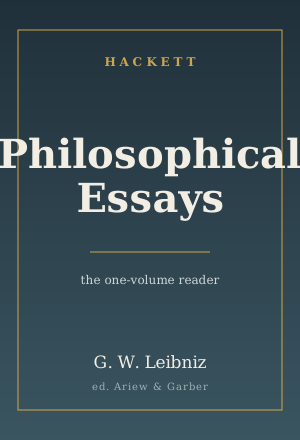
- Title
- Leibniz: Philosophical Essays
- Author
- G. W. Leibniz, ed. Roger Ariew & Daniel Garber
- Publisher
- Hackett Publishing (1989)
- Length
- Primary reader · ~384 pp.
- Difficulty
- Intermediate ★★☆ — a broad selection; read by parts
Check price & availability on the Amazon product page
What it is — in three lines
Because Leibniz never wrote a single systematic treatise, the best way to read him is a well-chosen anthology — and this is the anthology the field settled on. Roger Ariew and Daniel Garber assembled and translated a broad selection of the philosophical writings into one paperback: the famous short works, the great exchanges of letters, and the essays where Leibniz worked out his views on truth, freedom and necessity. For most English readers it is the single book that "is" Leibniz's philosophy.
The core — the system from every angle
Where the Monadology gives you the system as a finished summary, this reader lets you watch it being built and defended. You get the correspondence with Antoine Arnauld, in which Leibniz is pressed hard on the claim that each substance's complete concept contains its whole future — and has to spell out what that does and does not mean for human freedom. You get the correspondence with Samuel Clarke (Newton's ally), the classic debate over whether space and time are real things or merely relations between bodies. You get "On the Ultimate Origination of Things," the essays on necessary and contingent truths, and the pieces on the principle of sufficient reason. Read across the volume and the pillars from the introduction — monads, harmony, the best world, the complete concept — reappear as live arguments, tested against real objections rather than stated as doctrine.
Three highlights
1. The debates, not just the conclusions
The Arnauld and Clarke letters are the jewels here. Seeing Leibniz forced to defend himself against a sharp contemporary is worth more than any number of tidy summaries — this is philosophy as it actually happens.
2. The definitive editors
Ariew and Garber are among the leading editors of early modern philosophy in English, and their slim Hackett volume is drawn from this same work. The translations are the ones scholars cite; the apparatus is dependable.
3. One book you will not outgrow
Because it is broad, it lasts. Long after the introduction is shelved, this reader stays on the desk as the volume you return to whenever a secondary work sends you back to a source.
What to watch out for
Two notes. First — the governing one for this shelf — this book overlaps with the slim Discourse on Metaphysics and Other Essays. Both are Hackett, both are by the same editors, and the short works appear in each. Choose one: the slim volume if you only want to sample the Monadology cheaply, this reader if you want the correspondence and the wider selection. Buying both means paying twice for the Discourse and the Monadology. Second, an anthology is not meant to be read front to back like a novel: use the roadmap, start with the short works and the Arnauld letters, and let the rest wait until a question sends you to it.
Check price & availability on the Amazon product page