LAOZI / DAO DE JING BOOK GUIDE
The 5 Best Tao Te Ching Books in English (2026)
— from a poetic version to a fully annotated translation, in reading order
"The more you try, the more it slips away." Twenty-five centuries ago Laozi answered that feeling with a startling calm. The heart of the Tao Te Ching is wu wei — "non-doing": stop forcing, flow like water toward the low places, act in accord with the way things already are, and things come to completion of their own accord. The problem for an English reader is not scarcity but abundance: there are well over a hundred translations, and they disagree wildly — because every translation of this book is an act of interpretation. This page picks five, from an accessible poetic version to a translation carrying two thousand years of commentary, and is honest at every step about which are strict translations and which are interpretive renderings.
The editorial room behind this site runs a family of philosopher bookshelves and, in Japanese, a shelf comparing several rival translations of this same text. When you want to widen out from Laozi to Eastern and Western thought in general, our Philosophy Bookshelf takes over.
Our RankingRANKING
The editorial order. If you can't decide, start at #1. Check prices and availability on the Amazon product pages.
-
1
 If in doubt, start hereBeginner
Tao Te Ching: A New English Version
The best-selling English Tao Te Ching, and the gentlest doorway in. Mitchell's spare, luminous lines let wu wei and "the supreme good is like water" land in the body, not just the head — the ideal first contact. Be clear on what it is, though: an interpretive version made from other English translations, not a scholarly rendering of the Chinese. Meet Laozi here, then go deeper.
Check price & availability on Amazon / Kindle edition available
View on Amazon Read on Kindle Read our review -
2
 Beginner
Tao: The Watercourse Way
Not a translation but the worldview behind it. Watts's last book explains what Tao, wu wei, te (power/virtue) and li (organic pattern) actually mean, using the master image of water finding its own course. Read after Mitchell and the poem stops being a string of pretty riddles and becomes a coherent way of seeing. The friendliest bridge from "I liked it" to "I understand it."
Check price & availability on Amazon / Kindle edition available
View on Amazon Read on Kindle Read our review -
3
 Intermediate
Tao Te Ching (Penguin Classics)
Once the worldview is in place, this is the reliable scholar's translation to anchor it. D. C. Lau, a leading translator of the Chinese classics, renders all eighty-one chapters faithfully and adds an introduction, glossary and appendices on the text's disputed origins. Where Mitchell gives you the music, Lau gives you what the Chinese actually says — the standard against which the freer versions can be measured.
Check price & availability on Amazon / Kindle edition available
View on Amazon Read on Kindle Read our review -
4
 Intermediate
Tao Te Ching: A Book About the Way and the Power of the Way
A great novelist's fifty-year love letter to the book, and the best companion for reading translations side by side. Le Guin calls it a rendition, not a scholarly translation — she worked from the literal versions with the sinologist J. P. Seaton — and her chapter-by-chapter notes tell you exactly where she chose beauty over the letter. Set her next to Lau and you feel, in your hands, how much interpretation shapes this text.
Check price & availability on Amazon
View on Amazon Read our review -
5
 Advanced
Lao-tzu's Taoteching
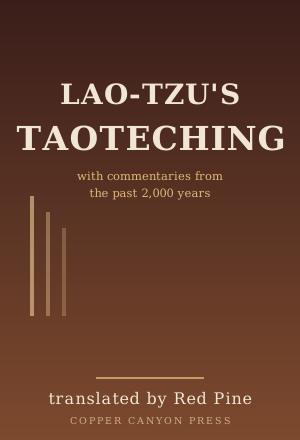
The destination of this shelf. Red Pine gives a precise translation with the Chinese en face, then — chapter by chapter — the voices of scores of Chinese commentators across two thousand years: monks, recluses, poets, emperors. You watch the tradition argue with itself over every line. This is the annotated original text, the place to settle in once the earlier books have given you your bearings.
Check price & availability on Amazon / Kindle edition available
View on Amazon Read on Kindle Read our review
The 5 Books at a GlanceCOMPARE
The biggest worry with the Tao Te Ching is choosing among a hundred translations. Choose by difficulty and by what each edition is for — and mind the line between a strict translation and an interpretive rendering.
| Title | Difficulty | Length | Type | Best for | Links |
|---|---|---|---|---|---|
| Tao Te Ching: A New English Versiontr. Stephen Mitchell · Harper Perennial | Beginner ★☆☆ | ~128 pp. ~2 hrs |
Interpretive version | First contact; you want the feeling before the scholarship | View on Amazon Review |
| Tao: The Watercourse WayAlan Watts · Pantheon | Beginner ★☆☆ | ~144 pp. ~4 hrs |
Context / worldview | You want to understand what Tao and wu wei mean | View on Amazon Review |
| Tao Te Chingtr. D. C. Lau · Penguin Classics | Intermediate ★★☆ | ~192 pp. ~5 hrs |
Scholarly translation | You want a faithful, reliable rendering of the Chinese | View on Amazon Review |
| Tao Te Ching: A Book About the Waytr. Ursula K. Le Guin · Shambhala | Intermediate ★★☆ | ~144 pp. ~4 hrs |
Poetic rendition (+ notes) | You want to read translations side by side | View on Amazon Review |
| Lao-tzu's Taotechingtr. Red Pine · Copper Canyon | Advanced ★★★ | ~200 pp. 1–2 weeks |
Translation + 2,000 yrs of commentary | You want the text argued over, line by line | View on Amazon Review |
A Reading Order That Won't Defeat YouROADMAP
There is really only one way to be defeated by the Tao Te Ching: to open a densely annotated scholarly edition first, before wu wei, water and "the way that can be told is not the eternal way" have taken hold in you — at which point it looks like a heap of disconnected riddles. Feel it first, understand the frame second, then descend into the translations. Climb in three steps.
-
STEP 1 ── Feel it first (one book)
Read Mitchell's New English Version
Start with the poetry, not the apparatus. Mitchell's version is short, clear and quietly beautiful; read it in an evening and let "the supreme good is like water" and "act without doing" sink in before you analyse anything. Just keep in mind it is an interpretation of interpretations — the ground floor, not the whole building.
Mitchell on AmazonRead on Kindle -
STEP 2 ── Understand the frame (books 2–3)
Watts's Watercourse Way for the ideas, Lau's Penguin for the faithful text
Now find out what you have been reading. Watts explains Tao, wu wei and te in plain, vivid prose, so the images cohere into a philosophy. Then D. C. Lau's Penguin Classics gives you a careful, scholarly translation of all eighty-one chapters — the reliable baseline that shows you how much the freer versions have shaped.
Watts on AmazonLau on Amazon -
STEP 3 ── Read the translations against each other (the goal)
Le Guin for the rendition, Red Pine for the tradition
Finally, read the text as the interpretive act it is. Le Guin's rendition, with her honest notes, beside Lau shows how two readers hear the same line differently; then Red Pine's edition — the Chinese en face and two thousand years of commentary — lets you watch the whole tradition argue over each chapter. Here "translation is interpretation" stops being a slogan and becomes something you can see. To widen out further, our Philosophy Bookshelf carries on.
Le Guin on AmazonRed Pine on Amazon
How We ChoseCRITERIA
Four criteria. First, currently in print and actually available on amazon.com — every title has a live product page from an established publisher (Harper Perennial, Pantheon, Penguin Classics, Shambhala, Copper Canyon Press). Second, the ladder must hold: feel it → understand the frame → read the translations against each other, each step preparing the next, with an entry point at every height from a two-hour poetic version to a fully annotated scholarly edition. Third, the set must show the range of the book itself — an interpretive version, a book of context, a faithful translation, a poetic rendition and a translation packed with classical commentary, so you feel how differently one text can be heard. Fourth, and most important for this book, honesty about what each edition is: because there are well over a hundred English Tao Te Chings and they genuinely disagree, every review states plainly whether you are holding a strict translation (Lau, Red Pine) or an interpretive rendering (Mitchell, Le Guin) or a book about the philosophy (Watts). Difficulty ratings and stars are the editorial room's own, not reproductions of Amazon reviews; the basis for each is stated in the review's editorial-room note.
Still Undecided? Take This OneCONCLUSION
If you have read this far and still can't choose, the answer is simple: start with Stephen Mitchell's New English Version. No book makes Laozi's central paradox — that things get done best when you stop forcing them — easier to feel than this one. Let "the supreme good is like water" settle into you, and the rest of the shelf, from Lau's faithful translation to Red Pine's two thousand years of commentary, turns from homework into pleasure.
Check price & availability on the Amazon product pages