Review: Tao Te Ching — A Book About the Way — the best companion for comparing translations
★★★★☆4.4 / 5.0 (editorial rating)
Verdict: a great writer's fifty-year devotion to this book, and the ideal partner for reading translations against one another. Le Guin is scrupulously honest: she calls this a rendition, not a scholarly translation, and her chapter-by-chapter notes tell you where she chose beauty over the letter. Placed beside Lau's faithful Penguin, it makes the invisible work of interpretation visible.
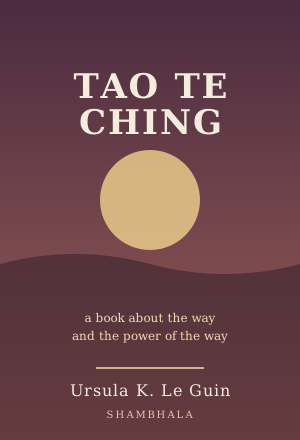
- Title
- Tao Te Ching: A Book About the Way and the Power of the Way
- Author
- Lao Tzu, English rendition by Ursula K. Le Guin (with J. P. Seaton)
- Publisher
- Shambhala Publications (this edition: 2019; first published 1997)
- Length
- Poetic rendition with notes · ~144 pp.
- Difficulty
- Intermediate ★★☆ — easy to read, rewarding to compare
Check price & availability on the Amazon product page
What it is — in three lines
Ursula K. Le Guin — one of the finest American novelists of the twentieth century, and a reader of the Tao Te Ching for more than fifty years — set out to make a version that "let the text speak in a fresh way to modern people" while staying true to the original. Not a reader of classical Chinese herself, she worked from the literal scholarly translations in consultation with the sinologist J. P. Seaton, and she is candid at every turn about what she is doing. She calls the result a rendition, and it is a poet's book to her fingertips.
Why it is the comparison book
What sets this edition apart is not just the beauty of the English but Le Guin's notes. Again and again she stops to tell you: here I departed from the literal sense, here I chose this word over that one, here is a chapter I never felt I understood. That running honesty turns the book into a masterclass in what translation of the Tao Te Ching actually involves — and makes it the perfect thing to read one chapter at a time beside a strict translation.
Do the not-doing, and there is nothing that is not put right.
— Laozi, Tao Te Ching ch. 3 (editorial gloss)
Set her Chapter 1 next to Lau's, then Mitchell's, and the abstract claim that "translation is interpretation" becomes something you can watch happening in front of you. This is where the whole shelf pays off.
Three highlights
1. A novelist's ear
Le Guin hears the poem as poetry. Her lines have a spareness and rhythm that reward reading aloud, and she is especially fine on the chapters about water, the uncarved block, and the mother of all things.
2. Notes that teach
The commentary is short, personal and illuminating — never academic throat-clearing. Because she flags her own choices and doubts, you learn to read any translation more critically.
3. Total honesty about method
By insisting on the word "rendition," and by naming her scholarly collaborator, Le Guin models exactly the kind of disclosure this shelf cares about. You always know what you are holding.
What to watch out for
Two honest notes. First — and Le Guin would be the first to say it — this is not the book to cite for "what the Chinese says." It is a poet's interpretive rendition; for fidelity you want Lau or Red Pine open alongside it. Read alone, its beauties could pass for the literal sense, which they are not. Second, its real value is comparative: as a stand-alone first Tao Te Ching it would work, but you would miss most of what makes it special. Read it as designed here — after a faithful translation, in dialogue with one — and it becomes one of the most rewarding editions in English.
Check price & availability on the Amazon product page