Review: Tao Te Ching — A New English Version — the gentlest way in
★★★★☆4.4 / 5.0 (editorial rating)
Verdict: the best first contact with Laozi in English. Short, clear, quietly beautiful — you can read it in an evening and come away actually feeling wu wei rather than just parsing it. One honest caveat governs everything below: this is an interpretive version, not a translation from the Chinese. As a doorway it is close to perfect; as your only Tao Te Ching it would be a mistake.
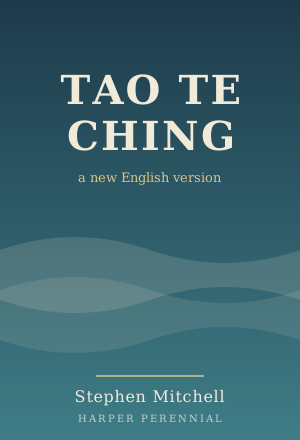
- Title
- Tao Te Ching: A New English Version
- Author
- Lao Tzu, version by Stephen Mitchell
- Publisher
- Harper Perennial (this version: 1988; original: c. 4th century BC)
- Length
- Interpretive version · ~128 pp.
- Difficulty
- Beginner ★☆☆ — reads in a single evening
Check price & availability on the Amazon product page
What it is — in three lines
Stephen Mitchell's rendering of Laozi's eighty-one chapters, first published in 1988, is the best-selling English Tao Te Ching of the modern era. Mitchell does not read classical Chinese; working as a poet and Zen practitioner, he built his text from the existing scholarly translations, aiming for something a contemporary reader could take to heart rather than merely construe. The result is a book of astonishing plainness and grace — and, deliberately, a free version rather than a literal translation.
Why it makes the best first book
The Tao Te Ching resists frontal assault. Read a heavily footnoted scholarly edition cold and the paradoxes — do nothing and nothing is left undone; the soft overcomes the hard — can look like a heap of fortune-cookie lines. Mitchell's gift is to make them land as experience. He clears away the apparatus so that the images do the work, and the central idea of wu wei arrives not as a doctrine to memorise but as a felt shift in how you hold your own effort.
The supreme good is like water, which nourishes all things without trying to; it flows to the low places others disdain.
— Laozi, Tao Te Ching ch. 8 (editorial gloss)
You can read it straight through in an evening, yet you close it holding the book's whole disposition toward the world. For a first encounter with a two-thousand-year-old Chinese classic, that ratio of ease to depth is exactly what you want.
Three highlights
1. "Act without doing" made intuitive
The famous wu wei — usually rendered "non-action" and immediately misunderstood as passivity — comes across in Mitchell as effortless, well-timed action, the way a good host or a skilled sailor works. It is the single hardest idea in the book, and this is the version that makes it click first.
2. Prose you will actually reread
Huston Smith called the book "as close to being definitive for our time as any I can imagine." Whatever one thinks of that as scholarship, it is true as reading: the lines are quotable, calming, and stay with you — which is why so many people who own five Tao Te Chings still reach for this one.
3. A safe on-ramp to a hard classic
Because it asks nothing of you — no Chinese, no history, no notes — it removes the usual reasons people abandon the text on page ten. It gets you in. Everything harder on this shelf becomes possible once you have.
What to watch out for
The honest warning, and it is the governing one for this whole site: this is not a translation. Mitchell reshapes, compresses, and occasionally departs from what the Chinese says — most notoriously changing pronouns and softening the harder political chapters. Scholars are sharply divided on it, and if you took Mitchell as "what Laozi wrote," you would be misled in places. Two defences. First, use it for what it is: the doorway, not the authority — which is exactly why it sits at #1 of a five-book ladder rather than alone. Second, plan to read it against a strict translation; the moment you set it beside D. C. Lau's Penguin or Red Pine's annotated edition, both books get better, and the gap between them teaches you more about the Tao Te Ching than either could alone.
Check price & availability on the Amazon product page