Review: Tao: The Watercourse Way — the worldview behind the poem
★★★★☆4.2 / 5.0 (editorial rating)
Verdict: the bridge from enjoying the Tao Te Ching to understanding it. Watts's last book is not a translation but an explanation of the whole way of thinking — Tao, wu wei, te, li — organised around one master image: water, which achieves everything by never forcing. Read it after Mitchell and the poem's riddles resolve into a coherent view of the world.
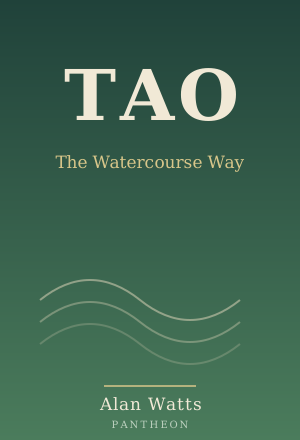
- Title
- Tao: The Watercourse Way
- Author
- Alan Watts, with Al Chung-liang Huang
- Publisher
- Pantheon Books (1975)
- Length
- Context / worldview · ~144 pp.
- Difficulty
- Beginner ★☆☆ — friendly, conversational prose
Check price & availability on the Amazon product page
What it is — in three lines
Alan Watts — the writer who did more than anyone to bring Taoism and Zen to a Western readership — treats Taoist philosophy here the way he treated Zen in his classic The Way of Zen: with clarity, wit and vivid analogy. Left unfinished at his death in 1973 and completed by his collaborator Al Chung-liang Huang, it is widely regarded as the fitting capstone to his life's work. It is a book about the ideas of the Tao Te Ching, not a translation of it.
Why it belongs at step two
Mitchell lets you feel the poem; Watts tells you what you were feeling. He walks through the core vocabulary — Tao (the way things move), te (the power or virtue that comes of moving with it), wu wei (not forcing), li (the organic patterning of things, the grain in wood, the markings in jade) — and shows how they lock together into a single outlook. The organising image is water: it seeks the low places, yields to everything, and wears away stone.
Nothing in the world is softer than water, yet nothing is better at overcoming the hard and strong.
— Laozi, Tao Te Ching ch. 78 (editorial gloss)
Once you have this frame, the freestanding lines you liked in Mitchell stop being isolated aphorisms and start pointing at one thing. That is precisely the readiness you want before opening a strict translation.
Three highlights
1. Wu wei as "not forcing"
Watts's translation of wu wei as "not forcing" — rather than the misleading "non-action" — is worth the price of admission on its own. It reframes the whole ethic as a matter of going with the grain of a situation rather than against it, and it is the clearest one-phrase gloss of the idea in English.
2. The image of the watercourse
By reading the entire philosophy through the behaviour of water and the grain of natural things, Watts gives you a single picture to hang everything on. It is the kind of unifying metaphor that makes an abstract system suddenly memorable.
3. Written to be enjoyed
Watts is simply a delight to read — warm, funny, allergic to jargon. After the compression of the poem, a few hours of his expansive, good-humoured prose is a genuine pleasure, and it makes the ideas stick.
What to watch out for
Two honest notes. First, this is interpretation, not scholarship. Watts was a brilliant populariser, not an academic sinologist, and specialists sometimes fault him for smoothing the tradition into a single congenial vision and downplaying its stranger, more religious and political sides. Take the book as one gifted reader's map, not the last word. Second, it is not the Tao Te Ching itself — it quotes and discusses the text but will not give you all eighty-one chapters. That is by design here: its job on this shelf is to hand you the worldview, after which D. C. Lau's faithful translation gives you the actual text to apply it to.
Check price & availability on the Amazon product page