Review: Tao Te Ching (Penguin Classics) — the reliable scholar's translation
★★★★☆4.5 / 5.0 (editorial rating)
Verdict: the baseline everyone should own. D. C. Lau's Penguin translation is faithful, restrained and scholarly — all eighty-one chapters rendered close to the Chinese, with a serious introduction on who "Laozi" was and how the text came down to us. Where Mitchell gives you music and Watts gives you the ideas, Lau gives you what the words actually say: the fixed point the freer versions can be measured against.
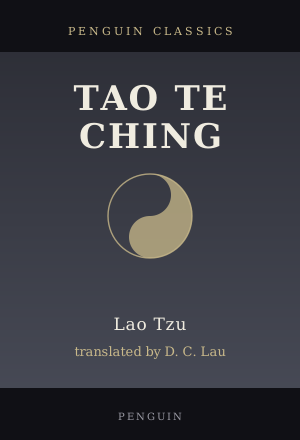
- Title
- Tao Te Ching (Penguin Classics)
- Author
- Lao Tzu, tr. D. C. Lau
- Publisher
- Penguin Classics (this translation: 1963; original: c. 4th century BC)
- Length
- Scholarly translation · ~192 pp. (text + introduction, glossary, appendices)
- Difficulty
- Intermediate ★★☆ — plain but demands attention
Check price & availability on the Amazon product page
What it is — in three lines
D. C. Lau (Lau Din-cheuk) was among the foremost translators of the Chinese classics into English; his Penguin versions of the Tao Te Ching, the Mencius and the Analects have been standard reading for generations of students. This Tao Te Ching, first published in 1963, renders all eighty-one chapters with care and adds a substantial introduction, a glossary and appendices addressing the vexed questions of the book's authorship and date. It is a genuine translation from the Chinese, made by a scholar.
Why it is the baseline translation
The virtue here is trust. Lau resists the temptation to prettify or to smooth over the hard, cryptic passages; where the Chinese is obscure, his English stays honestly close rather than inventing clarity. Read him after Mitchell and Watts and you get to check your intuitions against the text: the lines you loved are still here, but so are the difficulties the freer versions quietly dissolved.
The way that can be spoken of is not the constant way; the name that can be named is not the constant name.
— Laozi, Tao Te Ching ch. 1 (editorial gloss)
His introduction is a small education in itself — on the likelihood that "Laozi" is a composite rather than a single historical sage, and on how a book this short accreted this much authority. This is the point at which your reading acquires a spine.
Three highlights
1. Fidelity you can rely on
Lau's restraint is the whole value. When you want to know what a chapter says — not what a poet made of it — this is the version to consult. It functions as the shelf's reference standard.
2. A serious introduction and apparatus
The essay on authorship, dating and the nature of the text, plus the glossary and appendices, give you the scholarly context that a bare poetic version cannot. You finish it understanding not just the book but the problem of the book.
3. The measuring stick for every other version
Precisely because it is faithful, Lau turns your other editions into a conversation. Set Mitchell or Le Guin beside him, chapter by chapter, and you can finally see where interpretation begins — the single most instructive exercise a reader of this book can do.
What to watch out for
Two honest notes. First, fidelity has a price in music. Lau is clear and accurate but not lyrical; after Mitchell's glow, his plainness can feel dry, and a first-time reader who started here might wonder what the fuss was about. That is exactly why he sits at step two of this shelf rather than first — come to him once the poetry has already moved you. Second, his is one scholarly reading, not the scholarly reading. Later manuscript discoveries (Mawangdui, Guodian) and half a century of scholarship have moved some debates on; Lau remains an excellent, trustworthy translation, but it is a translation with a date, and Red Pine's commentary-rich edition is where you go to see the arguments continue.
Check price & availability on the Amazon product page