Review: Lao-tzu's Taoteching — the text argued over, line by line
★★★★★4.6 / 5.0 (editorial rating)
Verdict: the destination of this shelf. Red Pine gives you a precise translation with the Chinese en face, and beneath each chapter, the voices of scores of Chinese readers across two thousand years — monks, hermits, poets, emperors — disagreeing about what the line means. It is the annotated original text in the fullest sense: the place to settle in once the earlier books have given you your bearings.
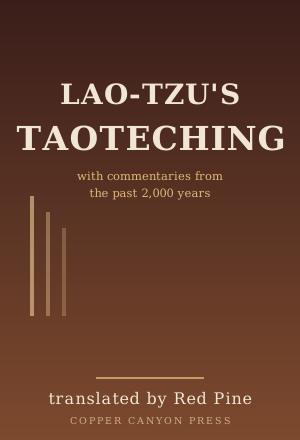
- Title
- Lao-tzu's Taoteching (with selected commentaries from the past 2,000 years)
- Author
- Lao Tzu, tr. Red Pine (Bill Porter)
- Publisher
- Copper Canyon Press (revised ed. 2009; original: c. 4th century BC)
- Length
- Translation + commentary · ~200 pp. (Chinese en face)
- Difficulty
- Advanced ★★★ — the commentary rewards slow reading
Check price & availability on the Amazon product page
What it is — in three lines
Red Pine is the pen name of Bill Porter, one of the foremost translators of Chinese literary and religious texts working in English. His Taoteching pairs a spare, accurate translation of all eighty-one chapters with the Chinese original printed alongside, and — the feature that sets it apart from every other English edition — a selection of commentaries by scores of Chinese scholars, Taoist adepts, poets, monks and rulers spanning more than two thousand years. Beneath each chapter, the tradition speaks for itself.
Why it is the destination
By this point you have felt the poem (Mitchell), grasped the ideas (Watts), anchored yourself in a faithful text (Lau) and watched interpretation at work (Le Guin). Red Pine completes the education: he shows you that the disagreement you saw between two modern translators has been going on inside China for two millennia. One commentator reads a chapter as mystical, the next as political, a third as a manual of breath and longevity — all from the same handful of characters, which you can see for yourself on the facing page.
Those who know do not talk; those who talk do not know.
— Laozi, Tao Te Ching ch. 56 (editorial gloss)
It is the difference between being handed a conclusion and being admitted to the argument. For a reader ready to go deep, nothing else in English does this.
Three highlights
1. Two thousand years of readers in one volume
The chorus of commentators is the book's glory. You are no longer reading one person's Tao Te Ching but the long conversation the Chinese themselves have held about it — a genuinely different experience of the text.
2. The Chinese en face
Even without reading Chinese, seeing the original opposite the English makes the book's famous compression visceral: a five-character line unfolding into a paragraph of English, and three commentators disagreeing about which unfolding is right.
3. A translation you can trust
Porter's own rendering is disciplined and unshowy — a real translation, not a version — so the commentary rests on solid ground. It is frequently cited as one of the best scholarly-yet-readable Tao Te Chings available.
What to watch out for
One honest note: this is not a first book, and it is not a quick read. The density of commentary that makes it great also makes it the wrong place to start — arrive here cold and the layered voices will bury the poem before you have heard it. That is exactly why it sits at #5 of a five-step ladder. Come to it after the others and the very same density becomes the payoff: every chapter opens into a two-thousand-year debate, and you finally read Laozi not as a slogan but as a living question. Give it weeks, not hours.
Check price & availability on the Amazon product page