JUSTICE BOOK GUIDE
The 5 Best Books on Justice (2026)
— Michael Sandel, in a reading order that won't defeat you
You wanted to think seriously about "what is justice?", picked up a fat theory book, and turned back at the wall of proper nouns. It happens to almost everyone. But justice has a staircase you can actually climb. Feel the pull of a single thought experiment — the runaway trolley — then widen your toolkit, get the map of the main theories from Sandel's Justice, and finish on the live arguments of our moment: money and merit. This shelf is ordered not by author but by readability and the sequence of questions — a map for not giving up.
The editorial room behind this site runs a family of philosopher bookshelves and a section-by-section reading archive of the primary texts. The same rule governs every shelf: never let the first book be the wrong one. A Japanese edition of this shelf is also maintained.
Our RankingRANKING
The editorial order. If you can't decide, start at #1. Check prices and availability on the Amazon product pages.
-
1
 If in doubt, start hereBeginner–Intermediate
Justice: What's the Right Thing to Do?
The book of Harvard's legendary "Justice" lecture course, and the modern standard for the whole field. Utilitarianism, libertarianism, Kant, Rawls and Aristotle are threaded into a single story through concrete dilemmas — the runaway trolley, the buying and selling of military service. If you want one map of the terrain, this is the shortest way to it.
Check price & availability on Amazon / Kindle edition available
View on Amazon Read on Kindle Read our review -
2
 Beginner
The Trolley Problem, or Would You Throw the Fat Guy Off the Bridge?
Divert the runaway trolley to save five, and one bystander dies — is the woman who pulled the lever guilty? Cathcart stages ethics' most famous thought experiment as a courtroom drama, with prosecution, defence, talk radio and public opinion all weighing in. Follow the trial and utilitarianism versus deontology settle into your head on their own. The ideal warm-up before Sandel.
Check price & availability on Amazon / Kindle edition available
View on Amazon Read on Kindle Read our review -
3
 Intermediate (contemporary)
The Tyranny of Merit: What's Become of the Common Good?
Isn't the very belief that "my success is my own achievement" what is deepening our divisions? Sandel takes on meritocracy and the tyranny of credentials head-on — exams, degrees, the dignity of work. This is the book where the theory of justice becomes most inescapably about you, and it set off a large public argument on both sides of the Pacific.
Check price & availability on Amazon / Kindle edition available
View on Amazon Read on Kindle Read our review -
4
 Intermediate (applied)
What Money Can't Buy: The Moral Limits of Markets
The right to skip the queue, naming rights, a price on a life — Sandel inspects a society in which the range of "things money can buy" keeps expanding, through a wealth of real examples. It takes the theoretical tools from Justice and puts them to work on one theme: markets and morals. The cases are so concrete you can enjoy it even before the theory book.
Check price & availability on Amazon / Kindle edition available
View on Amazon Read on Kindle Read our review -
5
 Beginner (toolkit)
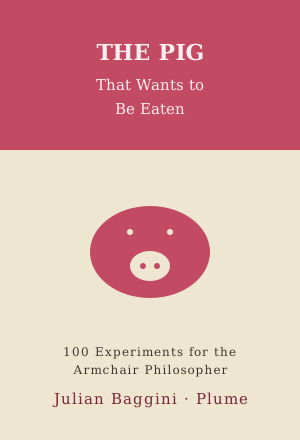
The Pig That Wants to Be Eaten: 100 Experiments for the Armchair Philosopher
From trolley-style dilemmas to personal identity, from God to the problem of evil, here are a hundred philosophical thought experiments, each just a few pages. There is no need to read front to back — graze the puzzles that catch you. A standing remedy for anyone who wants to train "thinking itself," not only justice, and perfect for the odd spare ten minutes.
Check price & availability on Amazon / Kindle edition available
View on Amazon Read on Kindle Read our review
The 5 Books at a GlanceCOMPARE
The biggest worry with a justice book is "is it too abstract — can I actually read it?" Choose by difficulty and format.
| Title | Difficulty | Length | Type | Best for | Links |
|---|---|---|---|---|---|
| Justice: What's the Right Thing to Do?Michael J. Sandel · FSG | Beginner–Intermediate ★★☆ | ~320 pp. 1–2 weeks |
Lecture course (the map of theories) | You want the whole picture of justice in one book | View on Amazon Review |
| The Trolley ProblemThomas Cathcart · Workman | Beginner ★☆☆ | ~208 pp. ~3 hrs |
Thought experiment (courtroom drama) | You want to feel one live question before the theory | View on Amazon Review |
| The Tyranny of MeritMichael J. Sandel · FSG | Intermediate ★★☆ | ~288 pp. 1–2 weeks |
Contemporary argument (meritocracy) | You want to face degrees and inequality head-on | View on Amazon Review |
| What Money Can't BuyMichael J. Sandel · FSG | Intermediate ★★☆ | ~256 pp. ~6 hrs |
Applied (markets and morals) | You want to use the theory on everyday examples | View on Amazon Review |
| The Pig That Wants to Be EatenJulian Baggini · Plume | Beginner ★☆☆ | ~320 pp. graze at will |
Thought-experiment collection (toolkit) | You want to practise thinking in spare moments | View on Amazon Review |
A Reading Order That Won't Defeat YouROADMAP
People give up on justice for two reasons: opening with a 320-page theory book, and staying in the abstract with no concrete question in hand. Feel a question → widen the toolkit → get the map → step into the live arguments. Climb in four steps.
-
STEP 1 ── Feel the question (one book)
Make the trolley problem your problem with The Trolley Problem
Switch the runaway trolley and five are saved but one other person dies. Cathcart lets you live through that single thought experiment as a trial. By the last page, the clash of utilitarianism and deontology is not "terminology" but your own hesitation, felt in the body. Skip this and go straight to the theory book, and you will skim across the surface.
The Trolley Problem on Amazon -
STEP 2 ── Widen the toolkit (fine in parallel)
Make thinking a habit with The Pig That Wants to Be Eaten
If the trolley problem gripped you, move to Baggini's sampler of a hundred puzzles of the same kind. Each is a few pages, so it moves on a commute, and there is no need to start at the front. Every book from Step 3 on leans on thought experiments, so building the habit of "changing the setup and rethinking" pays off here.
The Pig That Wants to Be Eaten on Amazon -
STEP 3 ── Get the map (the main event)
See the whole of justice with Justice: What's the Right Thing to Do?
Now Sandel's landmark. Utilitarianism (maximising happiness), libertarianism and Kant (respect for freedom), Aristotle (virtue and the common good) — the main approaches to justice are laid out along one path, each entered through a concrete dilemma. With Steps 1–2 behind you, the length will feel less "long" than "generous."
Justice on Amazon -
STEP 4 ── Into the live arguments (two applied books)
What Money Can't Buy → The Tyranny of Merit, applied to now
With the map in hand, step into the contemporary battlegrounds: markets and morals (the limits of what should be for sale), then meritocracy and division (is success really earned?). The inequality and credentials arguments in the daily news become readable in the language of justice. Reach here, and this shelf has done its job.
What Money Can't Buy on AmazonThe Tyranny of Merit on Amazon
How We ChoseCRITERIA
Four criteria. First, currently in print and actually available on amazon.com — every title has a live product page from an established publisher (Farrar, Straus and Giroux; Workman; Plume). Second, a ladder of difficulty and questions can be built: thought experiment → theory → live argument, each step preparing the next. Third, we hand you the tools and the map first, rather than pushing a particular political position or conclusion. Fourth, the character and the limits of each book — thought experiment, lecture course, applied study, contemporary argument — are stated plainly in each review. The editorial room runs a family of philosopher bookshelves and a section-by-section archive of the primary texts; those first-hand readings are the foundation here. On living authors we confine ourselves to comment grounded in the published work.
Still Undecided? Take This OneCONCLUSION
If you have read this far and still can't choose, the answer is simple: buy Justice: What's the Right Thing to Do? It is the modern standard that lets you survey the main theories of justice in a single volume, and whatever you read afterwards, you will be able to place it somewhere on the map. If 320 pages feels daunting, feel the trolley problem first in The Trolley Problem — that is this shelf's recommended route.
Check price & availability on the Amazon product pages