Home › Top 5 › The Trolley Problem
Review: The Trolley Problem — make the runaway trolley your own problem
★★★★★4.5 / 5.0 (editorial rating)
Verdict: the first book on justice. Ethics' most famous thought experiment, staged as a mock trial — follow the case of the woman who diverted a trolley to save five and killed one, and utilitarianism versus deontology settle into your head not as terminology but as your own hesitation. The best possible warm-up before you take on Sandel's longer books.
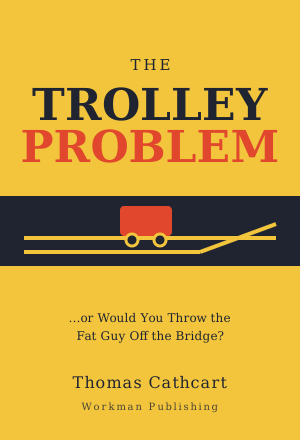
- Title
- The Trolley Problem, or Would You Throw the Fat Guy Off the Bridge?: A Philosophical Conundrum
- Author
- Thomas Cathcart
- Publisher
- Workman Publishing (2013)
- Length
- ~208 pp. · ~3 hrs
- Difficulty
- Beginner ★☆☆ — reads in an afternoon
Check price & availability on the Amazon product page
What it is — in three lines
Leave the runaway trolley on its track and five people die. Switch it to the side track and one person there dies instead — should you pull the lever? Cathcart takes this famous "trolley problem," first sharpened by the philosopher Philippa Foot, and builds it into a fictional trial: a woman who threw the switch and killed one to save five is prosecuted for murder. Prosecution and defence, radio talk shows and public opinion all take the stand, and the reader sits in the jury box, tugged from side to side.
The core — the invention of the courtroom
The trolley problem itself is by now almost over-familiar, retold in every introduction and internet explainer. What makes this the right first book is the invention of the trial as a form. When a textbook handles the trolley problem, it tends to end in a tidy summary: "the utilitarian says this, the deontologist says that." Here both positions arrive as advocacy that means to win. A few pages after you nod along with the claim that five lives outweigh one, you find yourself nodding at the counter-argument that a person must never be reduced to arithmetic. That experience of being pulled both ways is the doorway to ethics — and the finest preparation for the lecture-hall Sandel. Because it follows one case as a story, you can finish it in a few hours.
Is it permissible to turn the trolley to save five at the cost of one — and if so, why is it not permissible to push one large stranger off a footbridge to do exactly the same?
— editorial statement of the conundrum the book dramatises
Three highlights
1. The positions arrive as people
Utilitarianism and deontology are voiced not as abstract doctrines but by a prosecutor, a defence counsel, a witness. Noticing whose argument won you over doubles as a self-diagnosis of your own moral leanings.
2. Public opinion and the media as a third voice
Outside the courtroom, polls and TV commentary simplify the case. The gap between "what everyone says is right" and "what is right" is woven in — a theme that maps straight onto our social-media age.
3. A window onto the history of ethics
Behind the advocacy stand Bentham, Kant and the classics of moral philosophy. The arguments you get on nodding terms with here become three-dimensional when you meet them again in Sandel.
What to watch out for
Two notes. First, this is a book that drills deep into a single thought experiment, not one that hands you the whole map of justice. When you start to want that map, take it as the cue to move on to Justice: What's the Right Thing to Do?. Second, the trial is fictional and is not a guide to any real legal system; enjoy the courtroom purely as a stage device for pitting arguments against each other.
Check price & availability on the Amazon product page