Home › Top 5 › Justice: What's the Right Thing to Do?
Review: Justice: What's the Right Thing to Do? — the one map of the whole terrain
★★★★★4.6 / 5.0 (editorial rating)
Verdict: if you buy one book on justice, buy this one. The book of Harvard's legendary "Justice" lectures, and the modern standard for the field — the rival theories of justice are not listed but staged, each entered through a concrete dilemma, and threaded into a single story you can read straight through. Whatever you read afterwards, you will be able to place it on this map.
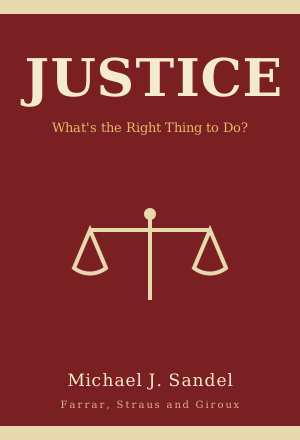
- Title
- Justice: What's the Right Thing to Do?
- Author
- Michael J. Sandel
- Publisher
- Farrar, Straus and Giroux (paperback, 2010)
- Length
- ~320 pp. · 1–2 weeks
- Difficulty
- Beginner–Intermediate ★★☆ — a lecture course in book form
Check price & availability on the Amazon product page
What it is — in three lines
Michael Sandel is a political philosopher whose Harvard course "Justice" became one of the most attended classes in the university's history and, later, a public television series watched around the world. This book grows directly out of that course. It walks through the major theories of what makes a society just — utilitarianism, libertarianism, Kant's ethics of freedom and duty, Rawls's fairness, and Aristotle's virtue and common good — and it does so not as a catalogue but as an argument you are pulled into, one dilemma at a time.
Why it's the standard first book
Most introductions to justice either simplify the theories into slogans or bury them in jargon. Sandel does neither. His method is to open each idea with a case you cannot shrug off — the runaway trolley, price-gouging after a hurricane, paying a stand-in to fight your war, affirmative action — and then let the competing principles fight over it in full strength. You feel the appeal of maximising overall welfare, then feel the force of the objection that a person is not a number to be summed, and the theory arrives as the name for a tension you have already lived.
To ask whether a society is just is to ask how it distributes the things we prize — income and wealth, duties and rights, powers and opportunities, offices and honours.
— Michael Sandel, Justice (editorial paraphrase of the book's framing question)
The result is the rare theory book that reads like a story yet leaves you holding the vocabulary of a whole discipline. That ratio of readability to coverage is why it has become the default first recommendation.
Three highlights
1. Theories entered through cases, not definitions
Bentham and Mill, Kant, Rawls and Aristotle each arrive attached to a dilemma you can argue about at dinner. You learn the position by taking a side and then being pushed off it — which is how the ideas actually stick.
2. The critique of the "neutral" liberal state
The later chapters turn to Sandel's own communitarian argument: that questions of justice cannot, in the end, be separated from questions about the good life and what we owe one another. Whether or not you agree, it is where the book stops being a survey and starts being philosophy.
3. A working glossary of public argument
Markets, merit, rights, obligation, the common good — the terms that dominate political debate are given precise, contested meanings here. After this book, the news reads differently.
What to watch out for
Two honest notes. First, this is not a neutral textbook. Sandel is a participant, and the closing chapters argue for his own view against the ideal of a value-neutral politics; read them as a strong position to test, not as the settled verdict of the field. Second, it is a survey, not a deep dive. Rawls's A Theory of Justice and the libertarian and utilitarian classics each repay far more study than a chapter can give; treat this as the map that tells you which territory to explore next, not as the territory itself.
Check price & availability on the Amazon product page