Home › Top 5 › What Money Can't Buy
Review: What Money Can't Buy — where the market should stop
★★★★☆4.4 / 5.0 (editorial rating)
Verdict: the most concrete way to put the theory to work. Sandel inspects a world in which almost everything is for sale — the right to skip the queue, naming rights, wagers on a stranger's death — and argues that a price can quietly degrade the very good it is attached to. The cases are so vivid you can enjoy it even before the theory book; as the applied companion to Justice, it is ideal.
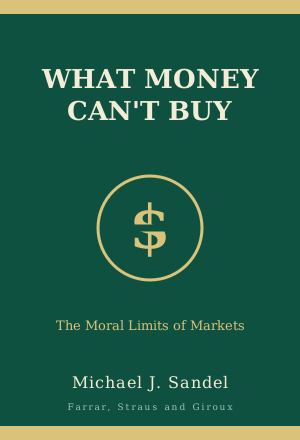
- Title
- What Money Can't Buy: The Moral Limits of Markets
- Author
- Michael J. Sandel
- Publisher
- Farrar, Straus and Giroux (paperback, 2013)
- Length
- ~256 pp. · ~6 hrs
- Difficulty
- Intermediate ★★☆ — applied, example-driven
Check price & availability on the Amazon product page
What it is — in three lines
Over the last few decades, Sandel observes, markets have quietly expanded out of the economy and into places they never used to reach — the right to jump a queue, a prison-cell upgrade, a company's life-insurance bet on its own employees, a sponsor's name on a public space. The book asks a deceptively simple question: are there some things money should not be able to buy, and if so, why? It answers not with a formula but through a parade of real, often startling examples.
The core — when a price corrupts
Sandel's central argument runs against a common economist's assumption that a market exchange, freely entered, leaves everyone at least as well off. His counter is that markets are not always neutral: attaching a price to certain goods can change and even degrade them. Pay a child to read and you may teach that reading is a chore to be compensated, not a pleasure to be had. Put friendship, honours, or civic duty up for sale and something in them dissolves. Two worries organise the book — fairness (do market choices reflect real freedom or real desperation?) and corruption (does the pricing spoil the good?) — and the second is the one he presses hardest.
The question of markets is really a question about how we want to live together — and about which goods are corrupted when we treat them as commodities.
— editorial paraphrase of the book's guiding question
Three highlights
1. Cases you will not forget
The examples do the philosophical work — line-standing markets, paid apologies, the trade in naming rights. Each is a small argument you can carry into your own life.
2. Fairness versus corruption
The two-part frame — is the deal fair, and does the pricing spoil the good? — is a portable tool you will find yourself using on markets Sandel never mentions.
3. A civic argument
The quiet thesis is that letting markets in everywhere erodes the shared life of citizens. It connects directly to the concern with the common good that runs through The Tyranny of Merit.
What to watch out for
Two notes. First, the book is stronger at raising the question than at drawing the line. Sandel is more concerned to show that a moral question exists than to tell you exactly where the market should stop — deliberately, but it can leave you wanting a sharper verdict. Second, it is an argument with a direction: defenders of markets have real replies, and reading it alongside the tools from Justice keeps you an assessor rather than a convert.
Check price & availability on the Amazon product page