Home › Top 5 › The Pig That Wants to Be Eaten
Review: The Pig That Wants to Be Eaten — a hundred puzzles to train the mind
★★★★☆4.3 / 5.0 (editorial rating)
Verdict: the toolkit for the whole shelf. A hundred philosophical thought experiments, each just a few pages — trolley-style dilemmas, personal identity, the problem of evil, the limits of knowledge. Graze the puzzles that catch you, in any order. Not a justice book as such, but a standing remedy for anyone who wants to train "thinking itself," and perfect for spare ten-minute stretches.
- Title
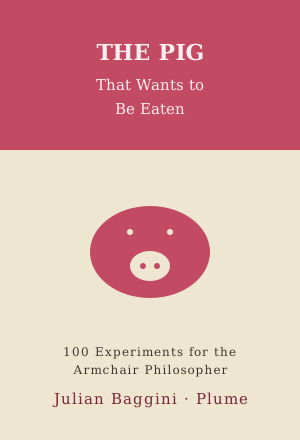
- The Pig That Wants to Be Eaten: 100 Experiments for the Armchair Philosopher
- Author
- Julian Baggini
- Publisher
- Plume (2006)
- Length
- ~320 pp. · graze at will
- Difficulty
- Beginner ★☆☆ — a few pages per puzzle
Check price & availability on the Amazon product page
What it is — in three lines
Julian Baggini, a British philosopher and skilled populariser, collects a hundred thought experiments — some classics of the trade, some drawn from fiction and film, some his own. Each gets a short vignette (the title one imagines a pig genetically engineered to want to be eaten) followed by two or three pages of commentary that opens up the philosophical stakes without closing them off. There is no argument running front to back; it is a book you dip into, not one you read through.
The core — a gym for the moral imagination
What makes this the right toolkit for a justice reader is the method it drills. A good thought experiment isolates one variable and asks you to judge — then changes the setup and asks again, so you feel exactly where your intuition bends. That is precisely the move Sandel and Cathcart make with the trolley, and Baggini gives you a hundred reps of it across every corner of philosophy. Do enough of them and you stop reacting and start noticing why you react — which is the skill every other book on this shelf quietly demands.
A thought experiment changes one thing and holds the rest still, so you can see which feature your judgement was really tracking.
— editorial gloss on how the book's puzzles work
Because each entry stands alone and takes minutes, it is the rare philosophy book that survives a commute, a queue, or a distracted evening.
Three highlights
1. Grazeable by design
A hundred self-contained pieces mean no lost place and no obligation to finish. You can chase whatever question is live for you today.
2. Range beyond ethics
Personal identity, free will, knowledge, the existence of God — the puzzles roam the whole discipline, so the habit you build here transfers well past justice.
3. Commentary that opens, not closes
Baggini rarely tells you the answer. He shows you the fork in the road and the cost of each path, which keeps the thinking yours.
What to watch out for
Two notes. First, this is breadth, not depth. Two pages cannot settle free will; the book is a sampler that points you toward the real debates, not a substitute for them. Second, it is not about justice in particular. Only some of the hundred bear directly on political philosophy; treat it as cross-training for the mind that runs alongside the shelf, not as a rung on the main climb.
Check price & availability on the Amazon product page