DEEP STATE BOOK GUIDE
The 5 Best "Deep State" Books (2026)
— credible analysis, and the conspiracy theory explained as one
"The deep state" means two very different things at once. To some writers it is a sober description of entrenched power — the permanent bureaucracy, the intelligence agencies, the national-security apparatus that outlasts any elected government. To others it names a sweeping conspiracy theory about a hidden cabal secretly running the country. This guide takes both seriously without confusing them: five books, all from established publishers, that let you understand the concept, the reporting, the scholarship, and the conspiracy phenomenon itself — in an order that builds real understanding.
Where this site stands: This is a book guide, not an argument for any claim. We do not endorse conspiracy theories, and we do not present conspiracy claims as fact. Titles are chosen for credibility — established publishers (Penguin, Norton, Oxford) and named, accountable authors — and the ranking is a reading order for understanding the topic, not a measure of agreement with anyone. Where a book analyzes the conspiracy theory, we frame it as exactly that: a study of the phenomenon. For the wider political and philosophical background, see our general Philosophy Bookshelf.
Our RankingRANKING
The editorial order as a reading path into the topic — not an endorsement of any book's claims. If you're new to the term, start at #1. Check prices and availability on the Amazon product pages.
-
1
 Start hereAccessible overview
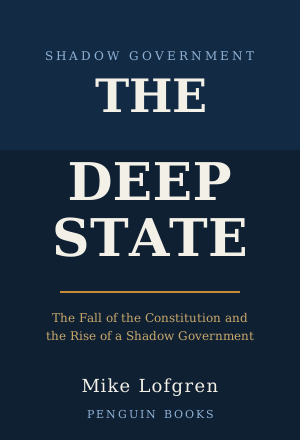
The Deep State: The Fall of the Constitution and the Rise of a Shadow Government
A former Republican congressional staffer's readable account of what he means by the "deep state" — not a secret cabal, but the entrenched network of security, financial and corporate power that persists across administrations. This is the serious, mainstream usage of the term, and the best plain-English place to see what the concept actually points at before the conspiracy versions arrive.
Check price & availability on Amazon / Kindle edition available
View on Amazon Read on Kindle Read our review -
2
 Journalistic account
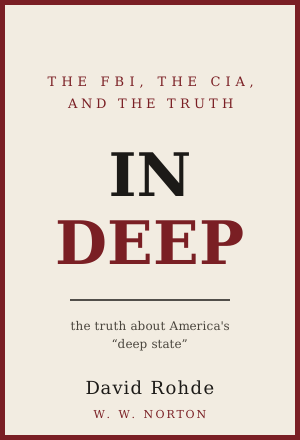
In Deep: The FBI, the CIA, and the Truth about America's "Deep State"
A two-time Pulitzer winner reports out the phrase. Drawing on interviews with career FBI and CIA officers, Rohde walks through fifty years of real scandals — from the Church Committee to Iran-Contra to Iraqi WMD to Snowden — to weigh where genuine unaccountable power exists and where the "deep state" label is political rhetoric. Reporting, not polemic.
Check price & availability on Amazon / Kindle edition available
View on Amazon Read on Kindle Read our review -
3
 Scholarly analysis
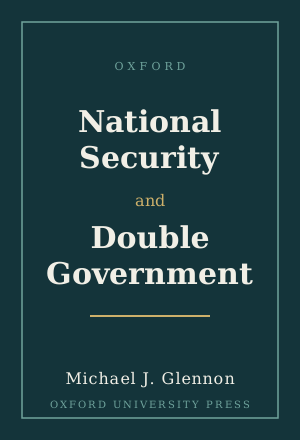
National Security and Double Government
The scholarly heart of the serious debate. A Tufts law professor argues that U.S. security policy is set less by the visible "Madisonian" institutions than by a permanent network of national-security managers — a "double government." An institutional, evidence-based analysis of unaccountable power, with no conspiracy in sight; this is what the term looks like when a constitutional lawyer takes it apart.
Check price & availability on Amazon / Kindle edition available
View on Amazon Read on Kindle Read our review -
4
 The theory, studied
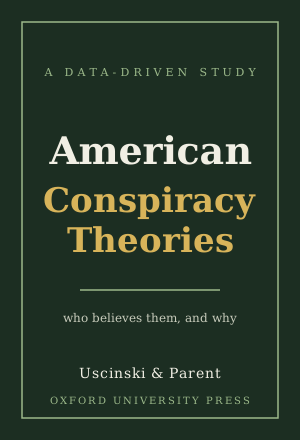
American Conspiracy Theories
Now the other meaning, examined as a subject. Two political scientists analyze who believes conspiracy theories, and why, using more than a century of data. Not a book that endorses or debunks any single claim, but the standard social-science account of how theories about hidden power — the "deep state" among them — actually work in a democracy. Essential for reading the conspiracy version critically.
Check price & availability on Amazon / Kindle edition available
View on Amazon Read on Kindle Read our review -
5
 Historical context
Real Enemies: Conspiracy Theories and American Democracy, World War I to 9/11
The historical backdrop that ties the two meanings together. A UC Davis historian shows how, across the twentieth century, real government secrecy and genuine abuses fed public distrust — and how that distrust curdled into conspiracy theory. From Pearl Harbor to Watergate to 9/11, it explains why "the government is hiding something" is sometimes true and often exaggerated, which is exactly the tension inside "deep state."
Check price & availability on Amazon
View on Amazon Read our review
The 5 Books at a GlanceCOMPARE
The key distinction is what kind of book it is: a credible analysis of real institutional power, reporting, or a study of the conspiracy theory. Read the "Type" column before you choose. Difficulty is the editorial room's own estimate, unrelated to any view on the content.
| Title | Type | Difficulty | Length | Best for | Links |
|---|---|---|---|---|---|
| The Deep StateMike Lofgren · Penguin Books | Accessible overview | Beginner ★☆☆ | ~320 pp. ~7 hrs |
First contact; what the term seriously means | View on Amazon Review |
| In DeepDavid Rohde · W. W. Norton | Journalistic account | Intermediate ★★☆ | ~320 pp. ~8 hrs |
You want reporting on the FBI/CIA, not opinion | View on Amazon Review |
| National Security and Double GovernmentMichael J. Glennon · Oxford UP | Scholarly (law / IR) | Advanced ★★★ | ~300 pp. ~10 hrs |
You want the rigorous institutional argument | View on Amazon Review |
| American Conspiracy TheoriesUscinski & Parent · Oxford UP | Study of the theory | Advanced ★★★ | ~240 pp. ~8 hrs |
You want to read the conspiracy version critically | View on Amazon Review |
| Real EnemiesKathryn S. Olmsted · Oxford UP | History | Intermediate ★★☆ | ~320 pp. ~9 hrs |
You want the century-long backstory | View on Amazon Review |
A Reading Order That Builds UnderstandingROADMAP
The trap with this topic is starting inside the most heated version of the story and taking the whole worldview on trust. The remedy is order: first the serious meaning, then the reporting and scholarship, and only then the conspiracy theory studied as a phenomenon — always keeping description and claim apart. Three steps.
-
STEP 1 ── Get the serious meaning (one book)
Start with Lofgren's The Deep State for the plain-English concept
Begin with Mike Lofgren's The Deep State. It shows the credible, non-conspiratorial sense of the term — entrenched security, financial and corporate power that outlasts elections — so that everything after it has a clear reference point. This is the concept before the mythology.
Lofgren's The Deep State on Amazon -
STEP 2 ── Weigh the evidence (books 2–3)
Rohde reports it out; Glennon analyzes the institutions
Next, test the concept against evidence. David Rohde's In Deep reports fifty years of real intelligence-agency scandals to sort genuine unaccountability from political rhetoric, and Michael Glennon's National Security and Double Government gives the rigorous, institutional version of the same worry — power without accountability, argued by a constitutional lawyer, with no conspiracy required.
In Deep on AmazonDouble Government on Amazon -
STEP 3 ── Understand the conspiracy theory (books 4–5)
Uscinski & Parent on why people believe; Olmsted on the history
Only now turn to the conspiracy dimension — studied, not swallowed. American Conspiracy Theories explains, with data, who believes such theories and why, and Real Enemies traces how real government secrecy across the twentieth century fed genuine distrust that sometimes hardened into myth. Together they let you read any "deep state" claim critically — telling the evidenced worry from the invented plot. To widen the political and philosophical frame, visit the general Philosophy Bookshelf.
American Conspiracy Theories on AmazonReal Enemies review
How We ChoseCRITERIA
Three criteria, and one firm position. First, credibility: every title comes from an established publisher (Penguin, W. W. Norton, Oxford University Press) and a named, accountable author — a former congressional staffer, a Pulitzer-winning reporter, a law professor, and academic political scientists and historians. We deliberately excluded self-published and conspiracy-promoting titles. Second, the two meanings, kept distinct: books 1–3 address the serious sense of "deep state" (entrenched, unaccountable institutional power), while books 4–5 examine the conspiracy theory as a phenomenon to be understood, not believed. Third, currently available on amazon.com, each with a live product page. And the position that governs all of it: this site does not endorse conspiracy theories and does not present conspiracy claims as fact. The ranking is a reading order for understanding the topic, not a measure of agreement. Difficulty ratings are our own editorial estimate, never Amazon customer reviews, and every description is written in our own words. We encourage reading widely and checking primary sources and multiple viewpoints before forming a judgment.
Still Undecided? Take This OneCONCLUSION
If you have read this far and still can't choose, start with Mike Lofgren's The Deep State. It gives you the credible, plain-English meaning of a phrase that is now used to mean almost anything — the entrenched institutional power that persists across administrations — so that you can tell the serious analysis from the conspiracy theory in everything you read afterward. Whatever you read, treat claims as claims: check primary sources and multiple viewpoints, and let the evidence, not the headline, decide.
Check price & availability on the Amazon product pages