Home › Top 5 › Double Government
Review: National Security and Double Government — the scholarly case, no conspiracy required
★★★★☆4.3 / 5.0 (editorial rating)
Verdict: the most rigorous book on the shelf, and the one that shows the serious worry needs no conspiracy at all. Glennon argues that the President, Congress and courts have become largely ceremonial in security matters, while a permanent network of managers — his "Trumanite network" — makes the real decisions. An institutional theory, built from the constitutional record, that earns the phrase "double government."
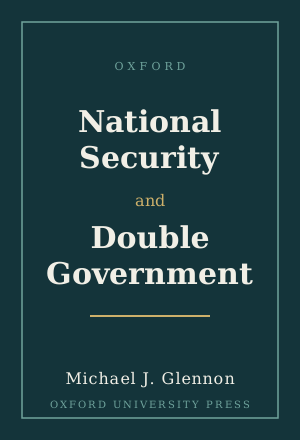
- Title
- National Security and Double Government
- Author
- Michael J. Glennon (professor of international law, The Fletcher School, Tufts University)
- Publisher
- Oxford University Press (paperback ed., 2016)
- Length
- ~300 pp.
- Difficulty
- Advanced ★★★ — about ten hours
Check price & availability on the Amazon product page
What it is — in three lines
A short scholarly book by Michael J. Glennon, a professor of international law at Tufts and a former legal counsel to the Senate Foreign Relations Committee. Borrowing the idea of "double government" from the Victorian analyst Walter Bagehot, it argues that American national-security policy is set by a concealed managerial network while the elected branches supply a reassuring but largely "dignified" façade. Academic, tightly argued, heavily footnoted.
The core — "double government"
Glennon's thesis is deliberately unglamorous, and that is its strength. There is no secret plot; there is a structural drift of power toward the several hundred officials who run the military, intelligence and law-enforcement agencies — people who stay while presidents come and go, and who operate largely beyond electoral or constitutional check. He documents how the "Madisonian" institutions increasingly ratify decisions made elsewhere, and why the system is stable precisely because it looks accountable. This is the deep-state intuition rebuilt as testable institutional analysis.
The visible institutions persist as a reassuring façade; the security network decides. Neither side conspires — the arrangement simply serves everyone who inhabits it.
— our editorial paraphrase of Glennon's argument (not a direct quotation)
Because the claim rests on the public record rather than on hidden actors, it can be argued with and tested — the opposite of a conspiracy theory.
Three highlights
1. A borrowed idea, put to work
Reaching back to Bagehot's distinction between the "dignified" and "efficient" parts of government gives the book a genuine analytical spine, not just a metaphor. It is scholarship, not commentary.
2. It removes the conspiracy
Glennon's most useful move is to show that unaccountable power can arise from ordinary institutional incentives, with no villain required. That reframing is what lets a careful reader take the worry seriously without sliding into paranoia.
3. Documented to the hilt
The extensive notes and the constitutional detail mean you can follow the evidence and disagree on the merits. That is exactly what a responsible treatment of this subject should invite.
What to watch out for
Two notes. First, this is the hardest book on the shelf — it assumes some comfort with U.S. constitutional structure and reads like the academic monograph it is; come to it after Lofgren and Rohde, not before. Second, it is a thesis, and a contested one: other scholars argue the elected branches retain more control than Glennon allows, so read it as a strong argument to be weighed, not a settled finding. Its value is the rigor, not the last word.
Check price & availability on the Amazon product page