Home › Top 5 › American Conspiracy Theories
Review: American Conspiracy Theories — the conspiracy theory, studied
★★★★☆4.2 / 5.0 (editorial rating)
Verdict: the book that lets you read the conspiracy version critically instead of falling for it or laughing it off. Uscinski and Parent treat conspiracy theories as a measurable social phenomenon — who believes them, when belief spikes, and why — using more than a century of data. It endorses no specific theory; it explains the machinery behind all of them, "deep state" included.
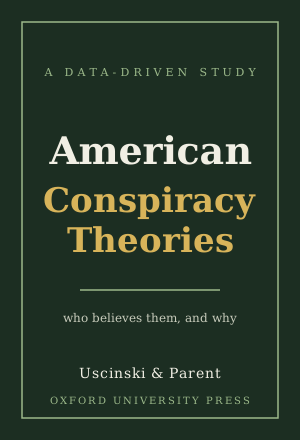
- Title
- American Conspiracy Theories
- Authors
- Joseph E. Uscinski & Joseph M. Parent (political scientists)
- Publisher
- Oxford University Press (2014)
- Length
- ~240 pp.
- Difficulty
- Advanced ★★★ — about eight hours
Check price & availability on the Amazon product page
What it is — in three lines
A landmark empirical study by political scientists Joseph Uscinski and Joseph Parent. Instead of asking whether any conspiracy theory is true, it asks a social-science question: who is drawn to conspiracy theories, under what conditions, and why do they rise and fall? The evidence base is unusually deep — including more than a century of letters to the editor of major American newspapers — which makes the conclusions data-driven rather than anecdotal.
The core — power and who believes
The authors' central finding is that conspiracy theories are, above all, a language of the weak about the strong: they cluster among those who feel shut out of power, and they spike when a group loses it. On this account "the deep state is secretly running things" is less a factual claim to be adjudicated than a predictable response to perceived powerlessness — which is exactly why the theory flourishes across the political spectrum depending on who is out of office. Crucially, the book neither confirms nor debunks the deep-state theory; it explains the conditions that make people believe it.
Conspiracy theories are for losers — not an insult, but a finding: they are the rhetoric of whoever is currently out of power, aimed at whoever holds it.
— our editorial paraphrase of the authors' thesis (not a direct quotation)
That framing is the single most useful tool on this shelf for reading any "deep state" claim with a cool head.
Three highlights
1. Data instead of impressions
The century-plus dataset means the claims about who believes and when are grounded in evidence, not the usual armchair psychology. It is genuine social science.
2. Even-handed by design
Because the theory tracks who is out of power, the book cuts across left and right without taking sides — a rare virtue in writing about conspiracy belief, and the reason we can recommend it as neutral.
3. It explains, it doesn't sneer
The authors take conspiracy belief seriously as a rational-seeming response to real power asymmetries, which is far more illuminating (and less condescending) than simple debunking.
What to watch out for
Two notes. First, it is academic political science: expect data, method and measurement rather than narrative, which is why we rate it Advanced. Readers who want the same territory in lighter form may prefer the authors' related, more general books, but this is the rigorous original. Second, it is a study of belief, not of any particular case — it will not tell you whether a specific deep-state allegation is true; for the historical record of real government secrecy behind such fears, read Real Enemies next. Use it as a lens, not a verdict.
Check price & availability on the Amazon product page