Review: Real Enemies — why real secrecy breeds conspiracy theory
★★★★☆4.2 / 5.0 (editorial rating)
Verdict: the book that ties the shelf together. Olmsted's history shows the uncomfortable truth behind "deep state" talk: across the twentieth century, the U.S. government really did keep secrets and really did abuse power — and those real abuses gave conspiracy theories their fuel. It is the context that explains why "the government is hiding something" is sometimes true, often exaggerated, and always potent.
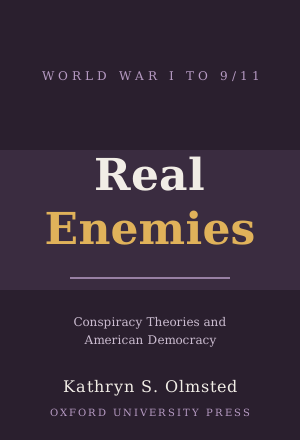
- Title
- Real Enemies: Conspiracy Theories and American Democracy, World War I to 9/11
- Author
- Kathryn S. Olmsted (professor of history, University of California, Davis)
- Publisher
- Oxford University Press
- Length
- ~320 pp.
- Difficulty
- Intermediate ★★☆ — about nine hours
Check price & availability on the Amazon product page
What it is — in three lines
A narrative history by Kathryn Olmsted, a historian at UC Davis, tracing conspiracy theories about the U.S. government from World War I to 9/11. Its distinctive argument is that the modern conspiracy-minded distrust of Washington grew directly out of the government's own real secrecy — as the security state expanded, so did both genuine abuses and the public's fear of them. History, accessibly written, with the archival grounding of a scholar.
The core — the feedback loop
Olmsted's key insight is a feedback loop between real conspiracies and imagined ones. Governments did lie — about Pearl Harbor's warnings, about covert operations, about Watergate, about the road to war — and each documented deception made the next wild theory more plausible to a wary public. She takes both halves seriously: the genuine abuses that justified suspicion, and the way suspicion then outran the evidence into full-blown myth. That is precisely the tension packed inside the phrase "deep state," shown across a century of cases.
Because the government really did conspire — and got caught — Americans learned to suspect it of conspiring even when it had not.
— our editorial paraphrase of Olmsted's argument (not a direct quotation)
Read after Uscinski and Parent, it supplies the historical flesh on their statistical bones: not just who believes, but why the record gave them cause.
Three highlights
1. It honors the real abuses
Olmsted never waves away genuine government wrongdoing to make conspiracy theorists look foolish. The Church Committee revelations and the like are treated as the serious history they are — which is what makes her account fair.
2. A century in one arc
Running from WWI to 9/11, the book turns scattered episodes — Pearl Harbor, the JFK assassination, Watergate — into a single, legible story of how American distrust of the state was built.
3. Balanced, and readable
It is scholarship that reads like narrative history, and it holds the line between explaining conspiracy theories and endorsing them — the same balance this shelf tries to keep.
What to watch out for
Two notes. First, it ends before the present: the original narrative closes around 9/11, so the specifically post-2016 "deep state" moment is recent context you will have to add yourself (a later anniversary edition adds an epilogue on it). Second, it is history, not adjudication — Olmsted explains why given theories took hold; she does not certify any of them as true, and neither do we. Read it as the backstory that makes the whole debate intelligible.
Check price & availability on the Amazon product page