Review: The Deep State — the plain-English meaning of a loaded phrase
★★★★☆4.1 / 5.0 (editorial rating)
Verdict: the best first book on the subject, because it recovers the term's serious meaning. Lofgren does not describe a secret cabal; he describes a durable network of national-security, financial and corporate power that runs on well past any election. Read it first and you will have a fixed reference point for telling credible analysis from conspiracy theory in everything that follows.
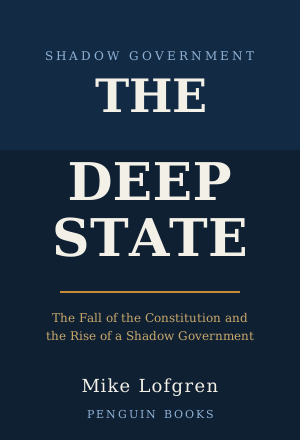
- Title
- The Deep State: The Fall of the Constitution and the Rise of a Shadow Government
- Author
- Mike Lofgren (former Republican congressional staff, House & Senate Budget Committees)
- Publisher
- Penguin Books (paperback ed.)
- Length
- ~320 pp.
- Difficulty
- Beginner ★☆☆ — about seven hours
Check price & availability on the Amazon product page
What it is — in three lines
An accessible book-length essay by Mike Lofgren, who spent twenty-eight years as a Republican staffer on the congressional budget committees. Expanding an essay that first popularized the phrase for an American audience, it argues that a "deep state" — his term for the entrenched machinery of security, finance and government-corporate revolving doors — increasingly sets the country's real priorities, regardless of who wins elections. It is analysis and argument, written for the general reader.
The core — what Lofgren actually means
The single most useful thing this book does is define the term responsibly. For Lofgren the deep state is not a hidden conspiracy of named villains; it is a structural, largely visible reality — the national-security agencies, the Treasury and Wall Street nexus, defense contractors, and the career officials who move among them. His claim is about incentives and institutions, not secret meetings. That distinction is the whole value of starting here: it gives you the credible core of the idea before the word gets stretched into something else.
The term describes a hybrid of national-security and financial power that operates according to its own logic, mostly beyond the reach of the ballot box.
— our editorial paraphrase of Lofgren's central thesis (not a direct quotation)
Read this way, the book is an argument you can weigh against evidence — which is exactly what books 2 and 3 on this shelf let you do.
Three highlights
1. It names the mechanism, not a cabal
Lofgren's power is institutional: budgets, careers, and the revolving door between agencies and industry. Because he points at structures rather than shadowy individuals, the argument stays testable — and stays clear of conspiracy theory.
2. An insider's vantage
Nearly three decades inside congressional budgeting give the book concrete texture about how money and priorities actually move in Washington. That first-hand vantage is what makes a potentially abstract thesis feel grounded.
3. Genuinely readable
This is trade non-fiction, not an academic monograph. The prose is brisk and the argument is built for a general audience, which is why it earns the "start here" slot even though the harder analysis comes later.
What to watch out for
Two honest notes. First, this is a polemic as well as an analysis — Lofgren has a clear point of view about American politics, and you should read it as an argued case, not a neutral survey. That is a reason to follow it with Rohde's reporting and Glennon's scholarship, which test the same worry more coldly. Second, the phrase has since been captured by very different, conspiratorial uses that Lofgren himself does not intend; keep his careful, institutional meaning in mind so you can see when later writers (or headlines) have swapped it for something looser. For the study of that conspiratorial usage, see American Conspiracy Theories.
Check price & availability on the Amazon product page